7 Everyday Knee Habits That Show Up a Decade Later
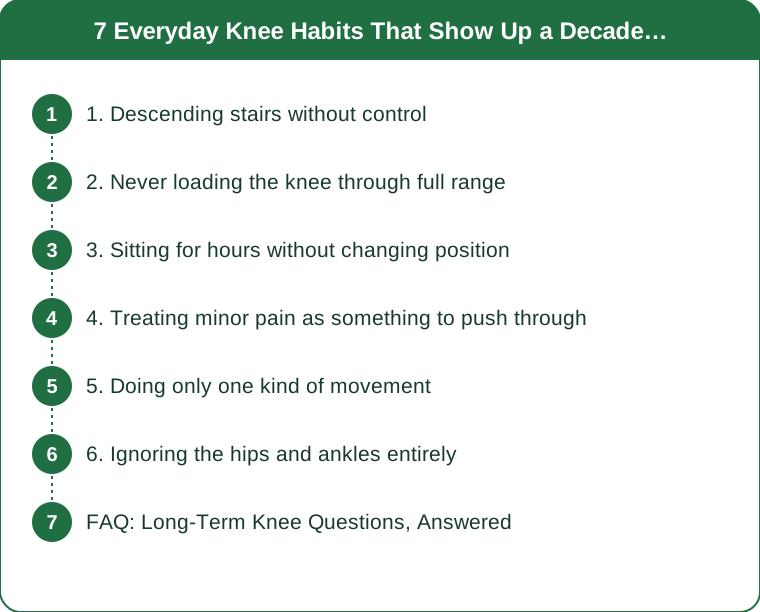
Quick Answer: The habits that damage knees over decades are mostly low-load and high-repetition — the way you descend stairs, how long you sit, whether you ever load the knee through full range, and how you respond to minor pain. None produce symptoms this year, which is why they last. The seven below are ordered by how much difference changing them makes, and every one of them is fixable in under a month.
Knees rarely fail suddenly.
They accumulate. Twenty years of one particular way of coming down the stairs, and then a Tuesday where it hurts.
Here are the seven worth changing before that Tuesday.

1. Descending stairs without control
Coming down stairs loads the knee at several times body weight, and doing it by falling from step to step turns a controlled eccentric into an impact.
The mechanism: the quadriceps should lower you. When it does not, the joint absorbs the drop instead. This is why descending hurts more than ascending in most knee complaints.
What to change: lead with a bent knee, land quietly, use the handrail when carrying anything. Quiet stairs are controlled stairs — if you can hear your own footfall thudding, you are dropping.
The fix that transfers: step-downs. Stand on a low step, slowly lower one heel to touch the floor, come back up. Three sets of eight a side, twice a week, and the pattern changes within weeks.
2. Never loading the knee through full range
Avoiding deep knee flexion feels protective and slowly reduces the range where the joint is strong.
The mechanism: tissue adapts to the range it is loaded in. A knee that never goes past 90 degrees under load becomes a knee that cannot tolerate going past 90 degrees under load.
What to change: if you are healthy, squat to a genuine depth regularly, even unloaded. Sitting down into a deep chair, kneeling, and getting up off the floor all count.
The caveat: if you have a diagnosed condition or existing pain, range progression should be guided rather than assumed. This is general information, not medical advice.
3. Sitting for hours without changing position
Sustained flexion is not damaging in itself, but eight hours of it every day changes what the surrounding tissue tolerates.
The mechanism: prolonged static positions reduce circulation through the joint, stiffen the surrounding tissue, and let the hip flexors and hamstrings shorten in ways that alter knee mechanics when you stand.
What to change: stand every 30 to 45 minutes, even for 60 seconds. The frequency matters more than the duration.
The tell: if standing up after a film requires a few careful steps before your knee feels normal, this is the habit talking.

4. Treating minor pain as something to push through
The most consequential of the seven, because it converts every other item on this list into an injury.
The mechanism: pain that lasts more than 24 hours after activity is a signal about load tolerance. Ignoring it repeatedly means training a knee that is already failing to adapt.
What to change: the 24-hour rule. Soreness gone the next morning is fine. Pain still present the next morning means the last session was too much — reduce load rather than stop entirely.
What to escalate: swelling, locking, giving way, or pain that wakes you at night. Those warrant assessment rather than management.
5. Doing only one kind of movement
Runners who only run and lifters who only lift both end up with knees that are strong in one direction and unprepared for everything else.
The mechanism: repetitive identical loading builds tissue capacity in a narrow pattern. Life is not narrow. Stepping off a kerb awkwardly is a lateral load that a purely sagittal training history has never prepared for.
What to change: add one session a week of something different — lateral lunges, step-ups at varied heights, cycling if you run, walking on uneven ground.
The lowest-effort version: walk somewhere with a hill and a rough surface once a week. Terrain variation does most of this for free.
6. Ignoring the hips and ankles entirely
The knee is the joint between two joints, and it takes the consequences of both.
The mechanism: weak glutes let the knee drift inward under load. Stiff ankles force the knee to compensate for lost dorsiflexion. Neither produces hip or ankle symptoms — they produce knee symptoms.
What to change: glute work twice a week (bridges, side-lying abduction, single-leg deadlifts) and ankle mobility work if your knee cannot travel forward over your toes in a lunge.
The self-test: stand on one leg. If your pelvis drops or your knee falls inward within ten seconds, the hip is the thing to work on.
7. Losing strength quietly through your forties
Muscle mass declines gradually from midlife onward without resistance training, and the knee is where the loss is felt first.
The mechanism: the quadriceps absorbs load the joint would otherwise take. Less muscle means more joint load doing exactly the same activities you have always done.
What to change: two resistance sessions a week, including loaded knee flexion and extension patterns. This is the single most protective habit on this list and the one most people skip.
The reassurance: strength responds at every age. Starting at 55 produces meaningful gains, and the research on this is unusually consistent.
Seasonal note: as the weather cools and outdoor activity drops, this is exactly the point in the year when strength quietly slips. Book the two sessions now rather than in January.
FAQ: Long-Term Knee Questions, Answered
Does running wear out your knees?
The evidence generally does not support this in recreational runners. Sudden increases in volume and running through pain are the risks, not running itself.
Should I use a knee brace preventatively?
Generally not without a specific indication. Braces are useful for specific instabilities and less useful as general insurance.
Do supplements help?
Evidence for glucosamine and chondroitin is mixed at best. Strength training has substantially better evidence than anything in a bottle.
What about clicking without pain?
Painless joint noise is extremely common and generally not a concern. Noise with pain, swelling or giving way is different.
Is it too late if I am already 60?
No. Strength, balance and range all improve with training at any age, and the functional difference is often larger than in younger people.
TL;DR:
- The damaging habits are low-load and high-repetition — stairs, sitting, and avoided range.
- Control your descent and never let stairs be a series of drops.
- Respect the 24-hour rule on pain. Soreness resolves overnight; pain that does not means reduce load.
- Train the hips and ankles — the knee pays for both.
- Two resistance sessions a week is the single most protective habit on the list.
Pick the stair one this week. It is free, it takes no time, and you do it forty times a day.
Keep Reading
This article is for general informational purposes only and is not medical advice. Always consult a qualified health professional for guidance specific to you.