7 Reasons Your Knees Ache More in Early Fall
Quick Answer: Early autumn knee pain is rarely one thing. Falling barometric pressure, cooler tissue, a sudden shift in activity type, less daylight for movement, changed footwear, holiday-season weight fluctuation and lower vitamin D all land within a few weeks of each other. The weather part is real but small; the behavioural parts are larger and are the ones you can actually change.
Here are the seven, in roughly the order they matter for most people.

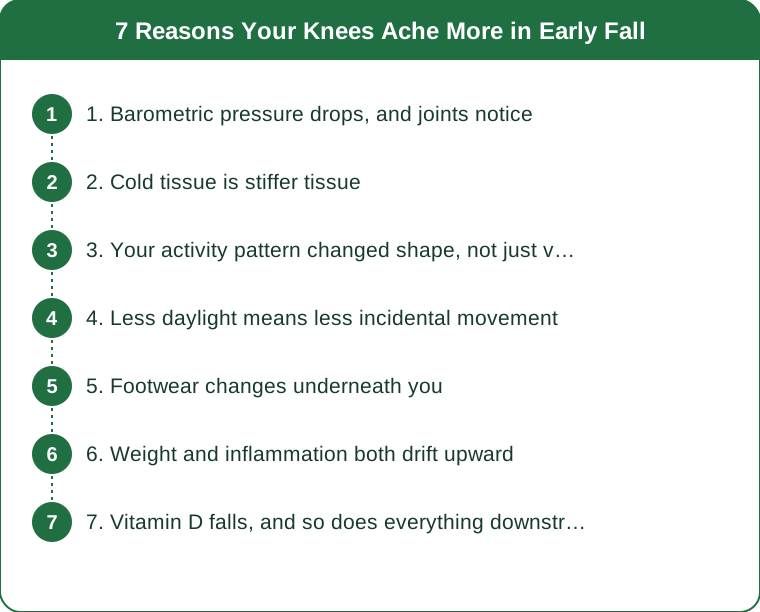
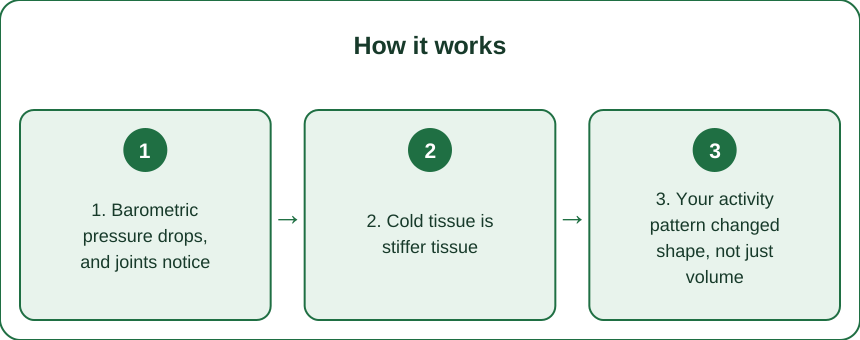
1. Barometric pressure drops, and joints notice
Falling atmospheric pressure allows tissues inside and around a joint to expand very slightly. In a healthy knee this is imperceptible. In a knee with existing inflammation, arthritic change or a previous injury, the capsule is already sensitive to pressure and that small expansion registers as ache or stiffness.
The research here is genuinely mixed. Some large studies find a measurable association between pressure drops and joint pain reports, others find the effect small or absent once you control for how people behave in bad weather.
What is not in dispute is that people feel it. The practical takeaway is not to dismiss it and also not to treat it as the whole explanation, because it is the one factor on this list you cannot do anything about, and the other six you can.
One useful reframe: if your knee reliably aches before a weather change, that is information about the sensitivity of that joint, not about the weather. A joint that reacts to a 10 hectopascal shift is telling you it is already irritated.
2. Cold tissue is stiffer tissue
Ligaments, tendons and the synovial fluid inside the joint all become measurably less compliant at lower temperatures. Synovial fluid is more viscous when cool, which is exactly why a knee feels gritty for the first few minutes of the day and looser after ten minutes of walking.
In September the effect shows up in a specific way: morning stiffness that was gone by August returns, and the first few minutes of any activity feel worse than the rest.
The fix is unglamorous and effective. Longer warm-ups. Five minutes of easy movement before anything demanding, rather than the ninety seconds that sufficed in summer. Walking before running, a set of bodyweight squats before loaded ones.
Covering the joint genuinely helps and is not just placebo. Skin temperature over a knee in leggings versus bare in 14 degree air differs by several degrees, and that carries into the superficial tissues.
3. Your activity pattern changed shape, not just volume
This is the biggest one and the least discussed.
Summer activity tends to be varied, outdoors and low-intensity-long-duration: walking, hiking, swimming, cycling. Autumn activity moves indoors and shifts toward concentrated sessions: gym classes, running programmes started in September, stairs instead of flat paths.
Knees respond badly to changes in the type of load even when total volume stays the same. A knee well-adapted to three hours of flat walking a week is not adapted to two hard leg sessions, and that mismatch produces exactly the anterior knee ache that shows up in the first weeks of a new routine.
The September programme surge makes it worse. Everyone starts something in September. New running plans, new gym memberships, new classes, all beginning at week one intensity simultaneously.
The rule that prevents most of it: change one variable at a time, and increase total load by no more than about ten percent a week.

4. Less daylight means less incidental movement
Knees do well on frequent low-grade movement, which keeps synovial fluid circulating and cartilage nourished. Cartilage has no blood supply and depends on compression and release to exchange nutrients.
As evenings darken, the after-dinner walk disappears first. Then the lunchtime walk shortens. The net effect is often several thousand fewer steps a day, spread as longer sitting blocks.
Long sitting is specifically hard on knees, because a bent, unloaded knee for hours produces the stiffness people notice standing up from a desk or a cinema seat.
A specific countermeasure: stand and move for two minutes every forty-five minutes of sitting. It is more effective for knee comfort than a single longer session, because it is the frequency that matters, not the duration.
5. Footwear changes underneath you
Sandals to trainers to boots is a real biomechanical change and it happens over about three weeks.
Heel height, sole stiffness, and cushioning all alter how force travels up from the ground. A stiffer sole changes ankle motion, which changes knee motion. A higher heel shifts the knee forward slightly, increasing patellofemoral load.
The most common autumn culprit is a pair of boots or trainers pulled out of the cupboard after six months. Midsole foam degrades with age and use, and shoes that felt fine in March may have significantly less shock absorption now.
The other one is new shoes started too fast. A running shoe with a different drop or a boot with a different heel needs a couple of weeks of gradual introduction, and almost nobody gives it that.
6. Weight and inflammation both drift upward
Two things happen quietly. Activity drops, and food changes. Autumn eating trends toward more calorie-dense meals, and the run-up to the holiday period starts earlier than most people admit.
Knee load is disproportionate to body weight. Walking on level ground puts roughly three to four times body weight through the knee, and stairs put more. Small increases in weight translate into meaningfully larger joint forces.
Inflammation is the other half. Less sleep, more sitting, changed diet and lower activity all nudge systemic inflammatory markers, and inflamed joints are more weather-sensitive and more load-sensitive.
None of this needs a dramatic intervention. Maintaining rather than gaining through autumn, and keeping protein and vegetables up as the weather turns, is enough to keep the joint load side of the equation flat.
7. Vitamin D falls, and so does everything downstream
Sun exposure sufficient for vitamin D synthesis drops sharply at higher latitudes from roughly September onward, and stores decline over the following months.
Low vitamin D is associated with muscle weakness and with more musculoskeletal pain, and the muscle side matters here: weaker quadriceps means less shock absorption at the knee.
This is a genuine talk-to-a-professional item rather than a self-prescribe one. Supplementation is common, safe at standard doses for most adults, and worth discussing with a doctor especially if you have limited sun exposure or darker skin.
FAQ: Autumn Knee Pain, Answered
Should I stop exercising when my knee aches?
Usually no. Reducing intensity while maintaining frequency is better than stopping, because knees stiffen further with rest. Sharp pain, swelling, locking or giving way are different and need assessment.
Does a knee sleeve help?
Many people find one helps, partly through warmth and partly through proprioceptive feedback. It is a comfort tool rather than a treatment.
Is cracking or clicking a bad sign?
Painless clicking is generally not concerning. Clicking with pain, swelling or catching warrants a look.
How long should new-routine knee ache last?
Mild ache that settles within a day or two of a new activity is usually adaptation. Ache that worsens week on week is not, and means the progression is too fast.
When should I see someone?
Swelling, locking, giving way, pain that wakes you at night, or pain that persists beyond a few weeks. This is general information, not medical advice.
TL;DR:
- Barometric pressure and cold tissue are real but small; the behavioural changes matter more.
- The biggest factor is a change in the type of load, not the amount, as summer walking becomes autumn training.
- Warm up for five minutes rather than ninety seconds, and cover the joint.
- Darker evenings cut incidental movement; move two minutes every forty-five.
- Check your autumn footwear for degraded midsoles and introduce new shoes gradually.
- Watch load progression at ten percent a week, and discuss vitamin D with a doctor.
Six of the seven are yours to adjust, which is better odds than the weather suggests.
Keep Reading
This article is for general informational purposes only and is not medical advice. Always consult a qualified health professional for guidance specific to you.