7 Reasons Your Knees Hurt More in Autumn
Quick Answer: Seven common causes: reduced daily activity as the weather turns, a sudden surge in indoor training volume, cold tissue producing stiffness that feels like joint pain, less sunlight and worse sleep amplifying pain perception, hillier or wetter surfaces changing loading, footwear switching from summer shoes to boots, and pre-existing arthritis genuinely feeling worse in cold damp conditions. Only the last is really about weather. Most autumn knee pain is a load change wearing a weather costume.
Work out which of the seven applies to you before deciding what to do about it - the fixes point in different directions.

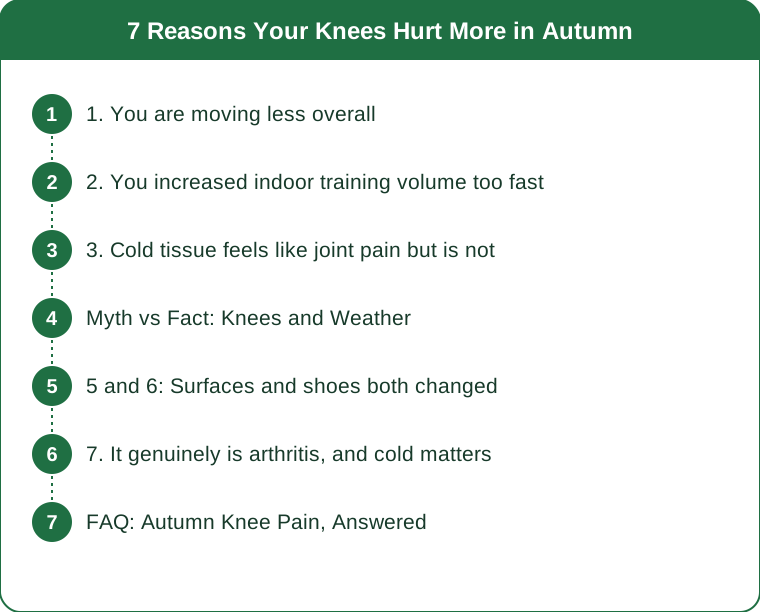
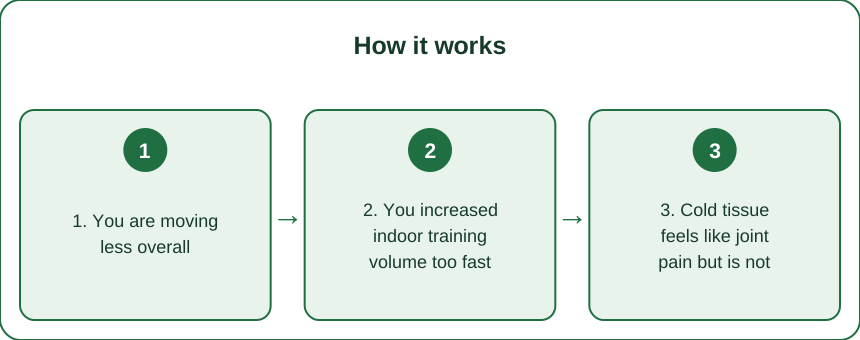
1. You are moving less overall
Daily step counts fall substantially from October for most people, and joints do worse with less movement, not more.
Cartilage has no blood supply and depends on movement for nutrition. Joint loading and unloading is how nutrients get in and waste gets out; a sedentary week is genuinely bad for a knee.
Stiffness after sitting is the tell. If the first few minutes of walking are the worst and it eases, that is the pattern of reduced movement rather than an injury.
The fix is more frequent short movement, not one long session. Standing up every hour does more for knee stiffness than a single evening walk.
Watch the desk and the sofa specifically. Autumn adds several hours a week of sitting for most people and almost nobody counts it.
And a short daily walk beats an intense weekly one for this particular cause.
2. You increased indoor training volume too fast
September is when people start programmes, and knee tissue does not adapt at the speed of enthusiasm.
Tendon and cartilage adapt more slowly than muscle. You will feel capable of more before your joints are ready for it, which is exactly how autumn overuse pain happens.
Ten percent per week is a reasonable ceiling for increases in running volume or lower body training volume.
Watch the new exercise, not just the volume. Adding lunges, step-ups, or spin classes introduces new loading patterns, and new patterns need their own ramp.
Pain that appears twenty-four to forty-eight hours after a session and builds week over week is the signature of doing too much too soon.
The fix is to hold volume rather than stop. Complete rest deconditions the tissue and the same volume hurts again on return.
3. Cold tissue feels like joint pain but is not
Cold muscle and tendon are stiffer, and stiffness around a joint is frequently interpreted as pain in the joint.
The quadriceps and the calf both cross or influence the knee, and both tighten in cold conditions.
Morning is worst because you are coldest and most static. Pain that eases within ten to fifteen minutes of movement is a stiffness pattern rather than a joint pattern.
Longer warm-ups fix a lot of this. Ten to fifteen minutes before training rather than three.
Warm clothing over the knee helps more than it should. Knee sleeves in cold weather work partly through warmth, and the effect is real even if the mechanism is modest.
And a warm shower before morning training is a legitimate intervention on cold days.

Myth vs Fact: Knees and Weather
Myth: cold weather damages your knees. Fact: it does not cause damage. It can increase pain perception and stiffness in already-affected joints, which is different.
Myth: knee pain in cold weather means arthritis. Fact: most autumn knee complaints in active people are load-related. Arthritis pain does track weather for many people, but it is a minority of the total.
Myth: you should rest a painful knee. Fact: complete rest deconditions the surrounding muscle and usually makes the return worse. Modified loading beats rest for most non-traumatic knee pain.
Myth: running is bad for knees. Fact: recreational running is associated with lower rates of knee arthritis than sedentary living in the available evidence. Rapid increases in running are the problem, not running.
Myth: barometric pressure explains it. Fact: pressure gets blamed constantly and the evidence is mixed and weak. Temperature and behaviour change have far more support.
Myth: knee clicking is a warning sign. Fact: painless clicking is extremely common and generally not meaningful. Clicking with pain, swelling, or locking is a different matter and warrants assessment.
5 and 6: Surfaces and shoes both changed
Wet leaves, mud, and uneven ground change how you load. Guarded walking on slippery surfaces means shorter steps and more co-contraction, and both increase knee loading.
Downhill is where autumn knee pain concentrates. Descending loads the quadriceps eccentrically and it is where wet-surface caution changes mechanics most.
Boots are a bigger change than people think. A stiffer sole, a raised heel, and more weight all alter knee loading relative to summer shoes.
New winter trainers matter too. A shoe change is a loading change, and knee or shin complaints that begin within two weeks of new footwear are usually about the footwear.
Treadmill running changes loading as well. Moving outdoor running indoors alters surface stiffness and typically cadence too.
Transition gradually. Alternate old and new shoes for two weeks rather than switching outright, and keep the first few sessions on a new surface shorter.
7. It genuinely is arthritis, and cold matters
For people with existing osteoarthritis, cold and damp conditions are commonly associated with worse symptoms, and the reports are consistent enough to take seriously even though the mechanism is not fully settled.
The pattern is different from load-related pain. Arthritis pain tends to be worse with inactivity, better with gentle movement, and worse again after excessive activity - and it comes with morning stiffness that eases within about thirty minutes.
Strength training is the best-supported intervention. Quadriceps and hip strengthening has better evidence than any brace, supplement, or gadget.
Warmth helps symptomatically. Heat before activity, knee sleeves for warmth, and keeping the room warm are all reasonable.
Keep moving through the winter. The seasonal dip in activity is what makes spring worse, and it is the most modifiable part of the pattern.
This is general information, not medical advice. Swelling, locking, giving way, night pain, or pain following a specific injury warrants assessment by a doctor or physiotherapist rather than self-management.
FAQ: Autumn Knee Pain, Answered
Does cold weather actually damage knees?
No. It can increase stiffness and pain perception in already-affected joints, but it does not cause damage.
Should I rest a sore knee?
Usually not completely. Modified loading - less volume, same frequency - beats rest for most non-traumatic knee pain, because rest deconditions the supporting muscle.
How do I tell load-related pain from arthritis?
Load-related pain builds over weeks with training increases. Arthritis pain is typically worse after inactivity, eases with gentle movement, and comes with morning stiffness that settles within about half an hour.
Do knee sleeves help in winter?
Many people find they do, largely through warmth and proprioceptive feedback. They are cheap and low-risk to try.
When should I see someone about it?
Swelling, locking, the knee giving way, pain at night, or pain after a specific injury. Also any pain that has not improved in six weeks.
This is general information, not medical advice.
TL;DR:
- Most autumn knee pain is a load change, not a weather effect - reduced daily movement and sudden training increases lead the list.
- Cartilage depends on movement for nutrition, so a sedentary autumn week is genuinely bad for a knee.
- Cold tissue stiffness is often misread as joint pain; if it eases within ten to fifteen minutes of movement, that is stiffness.
- Boots, new trainers, wet downhills, and treadmills are all loading changes - transition over two weeks rather than overnight.
- For existing arthritis, cold and damp genuinely correlate with worse symptoms; strength work is the best-supported response.
Swelling, locking, giving way, night pain, or pain after an injury needs assessment rather than self-management.
Keep Reading
This article is for general informational purposes only and is not medical advice. Always consult a qualified health professional for guidance specific to you.