7 Reasons Your Knees Hurt More on Vacation Than at Home
Quick Answer: Vacation changes almost every input your knees depend on — shoes, surfaces, daily step count, sitting duration, sleep position and training routine — usually all in the same 48 hours. The most common cause is not walking more, it is walking differently: unfamiliar shoes on uneven surfaces, with a sudden jump in volume, after a day of sitting still in a plane. Seven specific causes, and what to change for each.
You spent three months building up to comfortable knees. Then you went away for a week, did objectively less exercise than usual, and by day three you are looking for a pharmacy.
This is one of the most common patterns in knee complaints and one of the least discussed, because on paper you rested.
You did not rest. You changed seven variables at once.

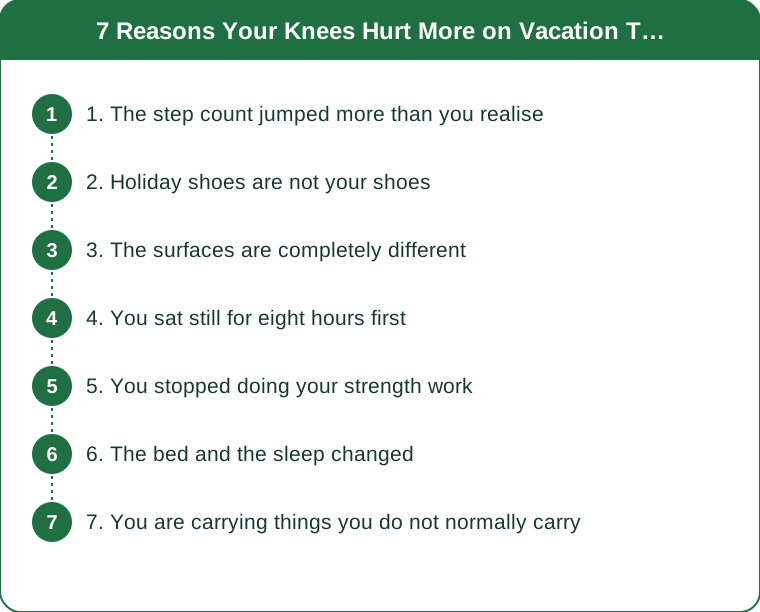
1. The step count jumped more than you realise
Most people substantially underestimate holiday walking.
A typical office day is 4,000 to 6,000 steps. A sightseeing day is routinely 15,000 to 25,000. That is a three to five times increase, sustained for consecutive days, with no build-up.
If a client told you they were going from 5,000 to 20,000 steps a day for seven days straight, you would call that an absurd training progression. On holiday it is Tuesday.
The specific problem is consecutive days. One big day is fine. Six in a row means tissue never gets a recovery window, and cumulative load is what irritates knees rather than any single effort.
What to change: plan one deliberately low day in every three. Not a rest day — a museum day, a boat, a long lunch. It preserves the trip and it is the single most effective intervention on this list.
And track it. Your phone already counts. Looking at day two’s number is usually enough to explain day four.
2. Holiday shoes are not your shoes
You walk 20,000 steps in sandals, or in the boots you wear twice a year, or in trainers you packed because they were light.
Shoes change knee loading through three routes: heel height alters the angle at the knee, cushioning changes impact absorption, and stability changes how much your foot rolls inward, which directly affects rotation at the knee.
The worst offenders on holiday:
- Flat sandals with no arch support for all-day city walking. The most common single cause in this whole article.
- New shoes bought for the trip. Never do this. A shoe needs two to three weeks of ordinary wear before a 20,000-step day.
- Backless shoes. Your toes grip to hold them on, which changes gait subtly and constantly.
- Very flat, very thin soles on stone streets. No cushioning against a surface with no give.
What to change: bring the shoes you actually walk in, even if they are ugly with the outfit. If you want a second pair, alternate days rather than replacing — different shoes load the knee differently, and rotating spreads the stress.
3. The surfaces are completely different
Home walking is mostly flat, predictable pavement. Holiday walking is cobblestones, sand, stairs, hills, uneven paths and sloped streets.
Uneven surfaces demand constant small corrections at the ankle, knee and hip. Each correction is minor; ten thousand of them is a workload your knees have not trained for.
Cobblestones specifically are brutal because the correction is unpredictable — you cannot anticipate the next stone, so the stabilising muscles fire reactively rather than in a rhythm.
Downhill is worse than uphill, always. Descending loads the quadriceps eccentrically and puts significantly more compressive force through the kneecap. A hilltop old town means the descent is guaranteed.
Sand is deceptively demanding. Walking on soft sand can raise energy cost substantially and changes ankle mechanics, which travels up the chain.
What to change: take stairs and steep descents deliberately slowly, and go down diagonally or sideways on the steepest sections. It looks odd and it drops patellofemoral load meaningfully.
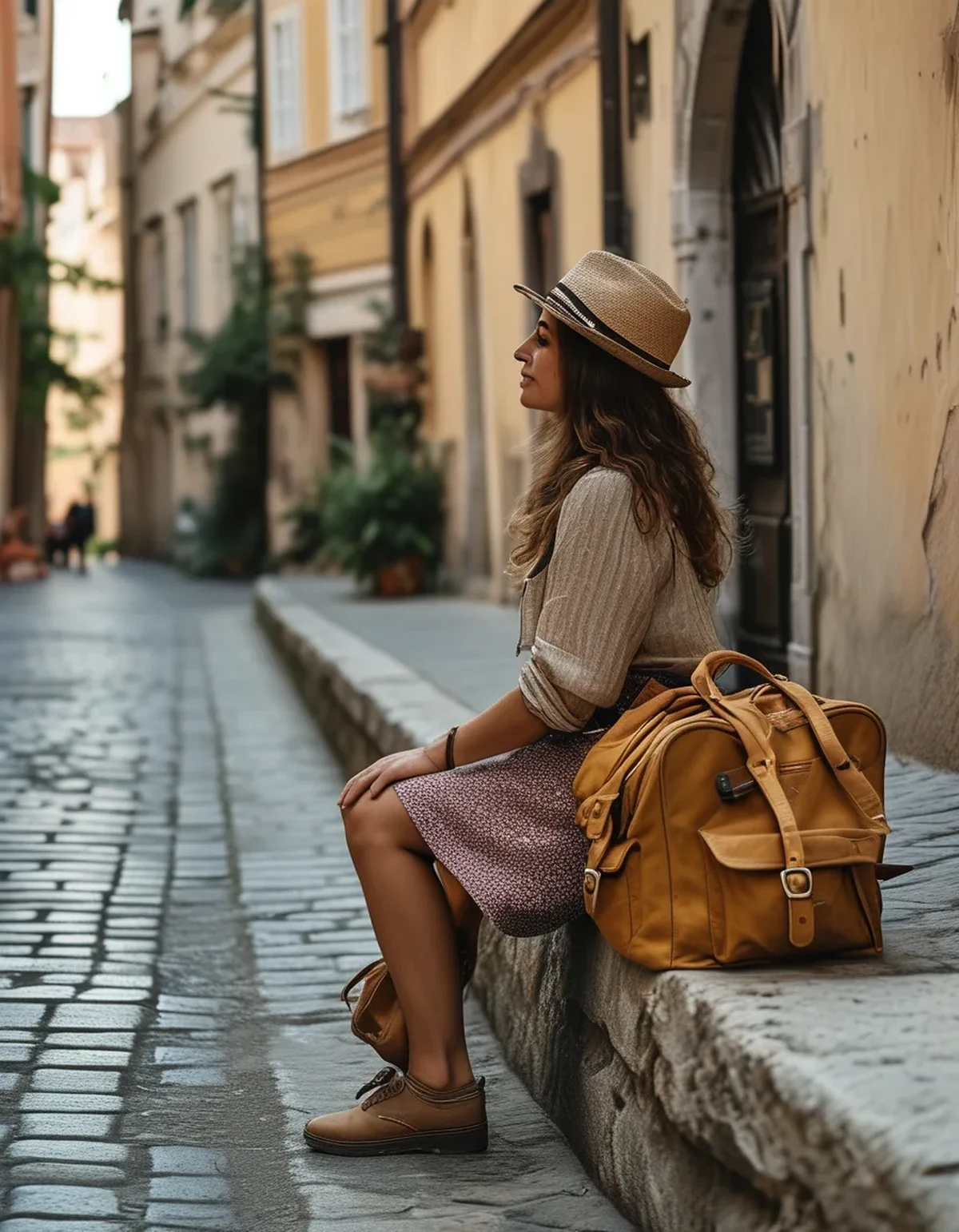
4. You sat still for eight hours first
The flight or the drive is not a neutral prelude. It is the setup.
Prolonged sitting with the knee bent at roughly 90 degrees for hours reduces circulation to the joint, allows synovial fluid to settle, and shortens the hip flexors and hamstrings. You then stand up and walk further than usual on the same day.
This is why day one or day two of a trip so often produces the first symptoms, and why people blame the walking rather than the sitting that preceded it.
Add cabin factors: mild dehydration, low humidity and reduced movement all affect connective tissue. Add the airport — standing on hard floors in queues, then rushing with a bag.
What to change: stand and walk for two minutes every hour on a flight or a long drive, without exception. On arrival day, take a 20-minute easy walk rather than either resting completely or going straight into a full day. Movement restores the joint far faster than rest does.
5. You stopped doing your strength work
This is the quiet one, and for people managing knee pain it is often the biggest factor.
If you have been doing knee-friendly strength work — step-ups, split squats, glute work, terminal knee extensions — those exercises are why your knees have been fine.
Then you go away for ten days and stop. The strength does not disappear in ten days, but the motor control and the tissue tolerance you have been building are actively maintained, not permanently banked.
Meanwhile the demand on your knees just tripled. Less support, more load, at the same time.
What to change: keep a five-minute version. Twenty bodyweight split squats per leg and thirty seconds of a wall sit, done in a hotel room before you go out. It is not a training session, it is a maintenance dose, and it is enough.
Do it in the morning, before the day happens. Evening intentions on holiday are famously unreliable.
6. The bed and the sleep changed
A hotel mattress that is too soft, a strange pillow, or a sofa bed at a relative’s house changes your sleeping position, and sleeping position affects morning knee stiffness considerably.
Side sleeping without a pillow between the knees lets the top leg drop across, rotating the hip and pulling the knee into an adducted position for hours. This is one of the most common causes of holiday knee stiffness and it is trivially fixable.
Sleep quantity also drops, and tissue repair happens during sleep. Late nights plus more physical load is a poor combination for a joint under new stress.
And the room is often colder or the air conditioning is aggressive, which many people with knee arthritis find genuinely aggravating.
What to change: pack a small pillow or use a rolled towel between your knees when side sleeping. Genuinely — a rolled hotel hand towel does the job. It costs nothing and it fixes a real mechanical problem.
7. You are carrying things you do not normally carry
A day bag with water, a camera, a jacket, snacks and souvenirs is easily 5 to 8 kilos, carried for ten hours.
Load carried on the body increases knee compression on every step, and it compounds over 20,000 of them. Carried on one shoulder, it also creates asymmetry — you lean to compensate, which loads one knee more than the other.
Then there is the luggage. Lifting a heavy case into an overhead bin, onto a train rack, or up four flights of stairs to an apartment involves loaded knee flexion in awkward positions, usually while tired.
What to change: use a proper two-strap backpack rather than a shoulder bag or a tote. Ruthlessly reduce what you carry — most day bags contain a jacket that was not needed and a book that was not read. And when lifting a case, turn to face it squarely and hinge at the hips rather than twisting.
This is general information, not medical advice. Knee pain with swelling, locking, giving way, or pain that persists more than a few days after returning home deserves a proper assessment rather than a rest week.
TL;DR:
- Sightseeing days routinely run 15,000 to 25,000 steps against a normal 5,000 — plan one low day in every three.
- Holiday shoes are the most common single cause; bring the shoes you actually walk in and never break in new ones on a trip.
- Cobblestones, hills and sand demand constant corrections your knees have not trained for, and every descent is worse than the climb.
- The flight sets it up: stand every hour, then take a 20-minute easy walk on arrival rather than resting or going straight into a full day.
- Keep a five-minute strength dose, put a rolled towel between your knees at night, and carry a two-strap backpack instead of a tote.
You did not overdo the walking. You changed shoes, surfaces, volume, sitting time, sleep position and strength work in the same forty-eight hours, and your knees noticed all seven.
Keep Reading
This article is for general informational purposes only and is not medical advice. Always consult a qualified health professional for guidance specific to you.