7 Things That Make Knee Pain Worse in Early Autumn
Quick Answer: Autumn knee flares are driven mostly by behavior change, not barometric pressure — shorter days cut daily step counts, footwear changes, indoor training replaces outdoor walking, and warm-ups get skipped in the cold. Address those seven factors and most seasonal flares soften considerably.
Every September, orthopedic clinics get busier and every knee patient has the same theory: it is the weather.
The weather is a small part of it. The rest is a set of changes you make without noticing, each of which loads your knees differently, all arriving in the same three weeks.
Here they are in order of how much they matter.
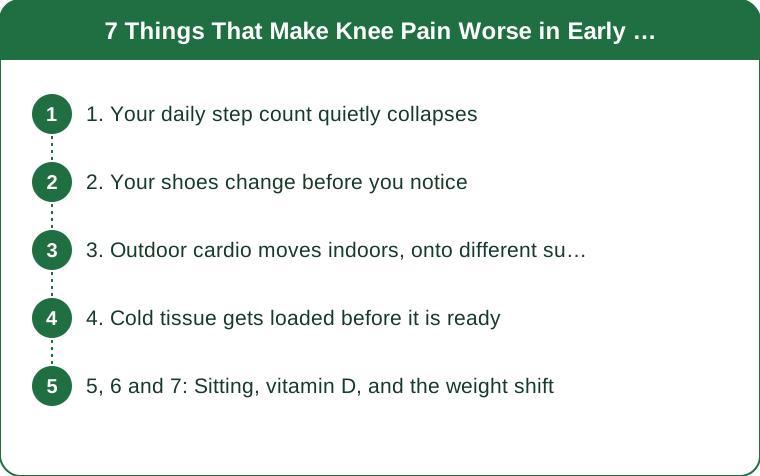
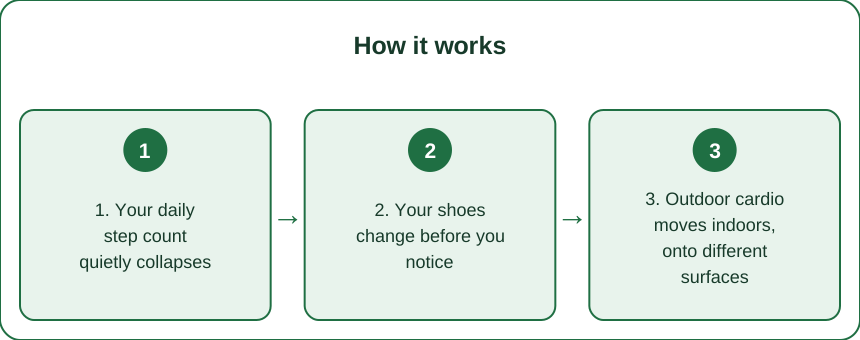
1. Your daily step count quietly collapses
This is the biggest one and almost nobody attributes their knee pain to it.
Daylight hours shrink fast in September — in the northern US, you lose roughly an hour of evening light across the month. The evening walk disappears, the lunchtime walk gets shorter, and the incidental movement of summer — walking to things, being outside — drops with it.
Cartilage has no blood supply. It gets its nutrition through the compression and decompression of movement, which pumps synovial fluid through the tissue. Less walking means less of that exchange, and stiffer, less well-nourished joints within a couple of weeks.
The cruel part is that stiffness makes you move less, which makes it stiffer. The single highest-value autumn intervention for knees is protecting your step count, even if the walk moves indoors, to a mall, or to a treadmill.
A useful target: whatever your August daily average was, do not let September fall more than 15% below it.
2. Your shoes change before you notice
Summer footwear comes off and autumn footwear goes on, and the shift is often significant.
Cushioning changes. Trainers worn all summer get swapped for boots, loafers, or shoes with harder soles and less shock absorption. That changes the impact load through the knee on every step.
Heel height changes. Even a modest heel shifts your center of mass forward and increases the flexion moment at the knee. Going from flat summer sandals to a two-inch boot heel is a real biomechanical change.
And the summer trainers themselves are worn out. Most people put the most mileage on their shoes in summer, then keep wearing the same pair into autumn. Midsole foam degrades at roughly 300 to 500 miles, and past that point it is providing far less cushioning than it feels like it is.
If your knees started complaining in the last three weeks, look at what is on your feet before you look at anything else.
3. Outdoor cardio moves indoors, onto different surfaces
Trails and grass become treadmills and gym floors, and the surfaces are not equivalent.
Treadmill running is not the same load as outdoor running. The belt assists slightly with leg turnover, cadence often changes, and people frequently run at a fixed 0% incline, which under-loads the posterior chain relative to natural terrain and shifts more work to the quads and knees. Setting 1% incline restores a closer approximation.
Group fitness classes reappear in September and are a classic flare trigger. Jumping, lunging, and lateral work at class intensity, after a summer of steady-state walking, is a large and sudden load increase.
The transition rule: when the mode of exercise changes, treat it as starting over at about 60% of your previous volume and build back over three weeks. Most autumn overuse injuries are people carrying their summer volume straight into a different movement pattern.
4. Cold tissue gets loaded before it is ready
This is where the weather genuinely does play a role, though not the way people think.
Barometric pressure effects on joint pain are real but modest and the research is mixed. Tissue temperature effects are much clearer. Cold muscle and tendon are less compliant, and cold reduces the sensitivity of the proprioceptive feedback that protects a joint through range.
The practical failure is that warm-ups get shorter exactly when they should get longer. Nobody wants to spend ten minutes warming up in a cold garage or a chilly park.
What to do: in cold conditions, extend the warm-up to 10 to 15 minutes and make it progressive — general movement first, then the specific pattern you are about to load. And warm up somewhere warm when you can. Walking out of a heated house into a cold street and immediately running is a worse start than five minutes of movement indoors first.
5, 6 and 7: Sitting, vitamin D, and the weight shift
5. You sit more. Autumn brings people indoors and onto sofas, and prolonged knee flexion is a specific aggravator for patellofemoral pain — it is literally called the theatre sign. Standing up every 30 minutes does more for anterior knee pain than most exercises do.
6. Vitamin D falls off a cliff. Above roughly 37 degrees latitude, skin synthesis becomes negligible from around October through March. Low vitamin D is associated with muscle weakness and has documented links to musculoskeletal pain. This is one of the few genuinely seasonal supplement cases, and it is worth a blood test rather than a guess — talk to your doctor.
7. Bodyweight starts drifting. Autumn is when weight typically begins climbing toward winter, and knee load is disproportionate to it. Load through the knee during walking is several times bodyweight, so even a small gain represents a meaningfully larger force through the joint on every step. This is not about aesthetics — it is the highest-leverage mechanical variable available for knee pain, and September is when the drift starts rather than when it is noticed.
Myth vs Fact: cold weather causes arthritis
Myth: Living somewhere cold, or being out in the cold, causes or worsens arthritis over time.
Fact: There is no evidence that cold climates cause arthritis or accelerate joint degeneration. What cold does is change the symptom experience — through tissue compliance, proprioception, and possibly pressure sensitivity. The joint is not getting worse in October and better in June; your perception of it and your behavior around it are what change. This matters practically, because people who believe cold is damaging their joints often reduce activity in winter, which is the one thing that reliably does make things worse.
This is general information, not medical advice. Knee pain with swelling, locking, giving way, or that wakes you at night should be assessed by a professional.
TL;DR:
- Protect your step count above everything else — cartilage nutrition depends on movement, and September step counts collapse quietly.
- Check your footwear: harder soles, added heel height, and worn-out summer trainers all change knee loading.
- When exercise moves indoors, restart at about 60% volume and build over three weeks; set treadmill incline to 1%.
- Extend warm-ups to 10 to 15 minutes in cold conditions and warm up somewhere warm when possible.
- Stand every 30 minutes, ask your doctor about vitamin D testing, and watch the autumn weight drift — knee load is several times bodyweight.
Keep Reading
This article is for general informational purposes only and is not medical advice. Always consult a qualified health professional for guidance specific to you.