7 Knee Signals You Should Never Train Through
Quick Answer: Stop training and get evaluated if you have knee swelling within hours of an injury, true locking, buckling or giving way, pain that wakes you at night, an inability to fully straighten the knee, pain that worsens rep over rep within a set, or any pain plus fever or redness. Ordinary training soreness is dull, symmetrical, and improves as you warm up. These seven do not.
Every lifter has a running internal argument about knees. Push through, or back off?
Most knee sensations really are noise — a stiff first set, a crunchy but painless squat, an ache that fades by rep six. Training through those is usually fine.
But there are seven signals where pushing through is how a two-week problem becomes a six-month one. The fourth one is the one people ignore most often.
This is general information, not medical advice.

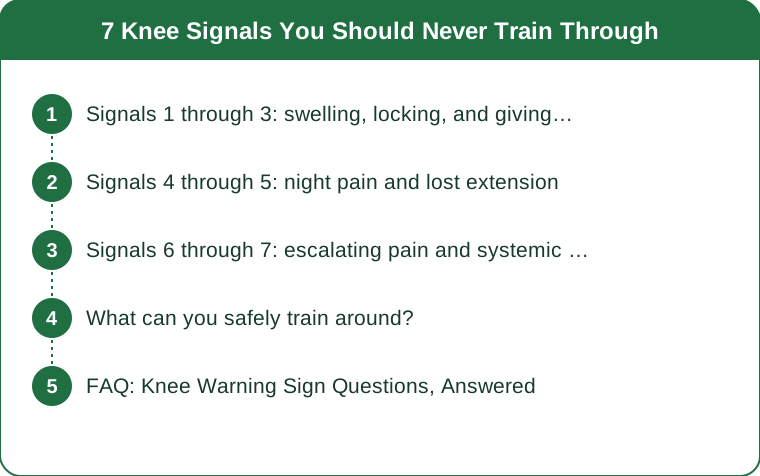
Signals 1 through 3: swelling, locking, and giving way
1. Swelling that appears within a few hours
Rapid swelling — a knee that is visibly larger the same day — suggests bleeding inside the joint. That is a different category from the slow puffiness that builds over a few days with overuse. Same-day swelling after a twist or impact needs evaluation, not ice and hope.
Practical test: sit with both legs out straight and compare the hollows on either side of each kneecap. If one side has lost its hollow, there is fluid in the joint.
2. True locking
Locking means the knee physically stops partway through its range and will not straighten until you wiggle or rotate it free. That is mechanical — often a torn piece of meniscus or a loose fragment sitting in the joint.
This is not the same as stiffness. Stiffness resists; locking blocks. If you have to maneuver the leg to unstick it, stop training that pattern.
3. Buckling or giving way
A knee that suddenly gives out under normal load — stepping off a curb, changing direction, walking down stairs — is reporting either ligament instability or a reflexive quad shutdown from pain.
Either way, the next episode may happen with a loaded barbell on your back. Buckling is the signal with the highest consequence-per-occurrence, and it is the one people most often laugh off.
Signals 4 through 5: night pain and lost extension
4. Pain that wakes you up
Mechanical knee problems generally quiet down when the joint is unloaded. Pain that wakes you at 3am, or that is worse at rest than during activity, points away from simple overuse.
This is the most under-reported symptom in the list, because people mentally file it under bad sleep rather than knee status. If you have woken up twice in a week because of your knee, that is data.
5. Inability to fully straighten
Put your heels on a bench, let both legs hang. Do both knees drop to the same flat position?
A knee that will not fully extend — even by 5 or 10 degrees — is either blocked by something mechanical or guarded by swelling. Lost extension is the single most important range to protect, because you cannot walk normally without it, and it becomes harder to recover the longer it persists.
Train nothing that keeps you from working on straightening. This is the one where waiting genuinely costs you.

Signals 6 through 7: escalating pain and systemic signs
6. Pain that gets worse rep by rep within a set
Normal training discomfort is stable or improves as tissue warms and synovial fluid distributes. A pattern where rep 1 is a 2 out of 10 and rep 8 is a 6 out of 10, consistently, means the tissue is being provoked rather than prepared.
Rule of thumb: pain that climbs within a set, or that is worse the next morning than immediately after, means the dose was too high. Cut range, cut load, or change the pattern.
7. Pain with redness, heat, or fever
A hot, red, swollen knee with any systemic symptom is an urgent evaluation, not a training question. Joint infection is uncommon but time-sensitive, and it does not resolve with rest.
Do not spend a weekend deciding on this one.
What can you safely train around?
Plenty, and this is the good news. Most knee issues let you keep training productively if you respect two rules: pain stays at or under about 3 out of 10, and it does not increase the next morning.
Usually still available:
- Hip hinges — RDLs, hip thrusts, back extensions load the posterior chain with minimal knee shear
- Partial-range squats to a box above the painful depth
- Isometric holds — a 45-second wall sit or Spanish squat often reduces tendon pain rather than aggravating it
- Upper body and core with zero restriction
- Cycling with a high saddle and low resistance
What to shelve temporarily: deep loaded knee flexion, plyometrics, running downhill, and any cutting or pivoting.
Reintroduce one variable at a time, and give each one 48 hours before adding the next. Most people fail here by fixing the knee, feeling great, and returning to everything at once.
FAQ: Knee Warning Sign Questions, Answered
Is knee crunching or grinding a bad sign?
Painless crepitus is extremely common and correlates poorly with joint damage. Noise plus pain, swelling, or catching is worth investigating; noise alone usually is not.
How long should I wait before seeing someone?
For the seven signals above, days not weeks — and immediately for the fever or redness one. For a low-grade ache that is not improving, two to three weeks of sensible modification is a reasonable trial before getting it looked at.
Does knee pain mean I should stop squatting forever?
Almost never. Most people return to full squatting after modifying depth, load, and stance width for a period. The knee that never gets loaded gets weaker, and weaker knees hurt more.
TL;DR:
- Get evaluated for: same-day swelling, true locking, giving way, night pain, lost extension, pain climbing within a set, or any redness and fever
- Lost full extension is the most urgent of the everyday signals
- Safe to train around: hinges, partial-range squats, isometrics, upper body, easy cycling
- Keep pain at or under 3 out of 10 and never worse the following morning
Run the heel-hang extension test tonight. It takes ten seconds and it is the most useful self-check on this entire list. General information, not medical advice — see a professional for anything on the seven.
Keep Reading
This article is for general informational purposes only and is not medical advice. Always consult a qualified health professional for guidance specific to you.