7 Reasons Carrying a Bag on One Side Is Straining Your Knees
Quick Answer: A bag on one shoulder makes you lean away from the load, which shifts your weight onto the opposite leg, changes how your hip and knee track with every step, and does it thousands of times a week. The result is usually pain in the knee on the side you do not carry on. Switching sides helps; switching to a two-strap or cross-body bag helps far more.
This is general information, not medical advice.

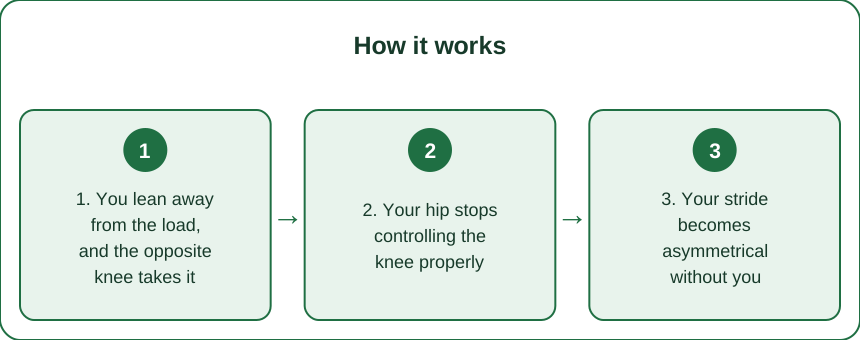
1. You lean away from the load, and the opposite knee takes it
Your body counterbalances automatically. Hang eight kilograms off the right shoulder and your torso tilts left to keep your centre of mass over your feet. That shift moves a disproportionate share of your body weight onto the left leg with every step.
More load means more work at the joint. Knee joint forces during walking are already several times body weight, so a persistent shift in weight distribution is not a trivial change.
And it is the left knee that hurts. This is the detail that confuses people — the pain shows up on the side you are not carrying on, which is why the bag rarely gets blamed.
Test it yourself in ten seconds. Load your usual bag onto your usual shoulder in front of a mirror and look at where your head sits relative to your feet. Almost everyone is visibly off-centre, and almost nobody has noticed.
2. Your hip stops controlling the knee properly
The gluteus medius keeps your pelvis level while you are standing on one leg, which is roughly forty percent of every walking cycle.
A one-sided load overloads it on one side and underuses it on the other. Over months, that asymmetry becomes a strength difference rather than just a positional one.
When the hip stops controlling rotation, the knee absorbs it. A knee that drifts inward on each step is being poorly steered from above, and inward knee drift is one of the most consistent findings in people with anterior knee pain.
The knee has almost no rotational range of its own. It is built to bend and straighten. Rotation is supposed to come from the hip and the ankle, so whenever those two stop supplying it, the knee is absorbing movement it was never designed to produce.
3. Your stride becomes asymmetrical without you noticing
Step length shortens on the loaded side. Gait studies of asymmetric carrying consistently show reduced step length and altered timing on one side.
Asymmetric gait changes how force enters the knee. A shorter step on one side means a different landing angle, and different angles concentrate force in different parts of the joint.
You will not feel it happening. Gait changes below a certain magnitude are entirely invisible from the inside, which is why the first sign is usually pain rather than awareness.
Someone else will see it before you do. Ask a friend to walk behind you for thirty seconds with and without the bag. The difference in shoulder height and hip movement is usually obvious to an observer and invisible to the person walking.

4. It is the repetition, not the weight
A ten-minute walk to the station twice a day is roughly four thousand steps under load, every week. No single step is a problem; four thousand slightly wrong ones repeatedly is a different question.
Tissue responds to cumulative load. Cartilage, tendon and the structures around the kneecap adapt well to load that is varied and poorly to load that is identical and constant.
Which is why it appears gradually. Nobody hurts their knee on a Tuesday because of a tote bag. It emerges over a season, which makes the connection easy to miss.
And it resolves gradually too. People who change their bag expect the knee to feel better within days and give up when it does not. Give any change four to six weeks before deciding it did nothing.
5. Heavier autumn clothing and bags stack the effect
Bags get heavier as the weather turns. An umbrella, a jumper, gloves and a water bottle add up, and the same bag can gain a couple of kilograms between September and November without you repacking it.
Footwear changes at the same time. Moving from summer trainers to boots alters heel height and cushioning, which changes knee loading independently.
Activity levels usually drop too. Less general walking and less strength work through autumn means less capacity at the exact point the load goes up, and that combination is why knee complaints cluster in the season change.
Empty the bag once a week. Most people are carrying two or three items they have not used in a month, and a bag audit is the fastest weight reduction available to anyone.
Cold tissue tolerates less, too. A knee that is stiff for the first ten minutes of a cold morning walk is being loaded before it is ready, and a one-sided load meets it at exactly the wrong moment.
6 and 7. Two more you can fix this week
6. You always carry on the same side
Almost everyone has a dominant carrying shoulder and uses it by default. Consistency is the problem — the same tissue takes the same load in the same direction every day with no variation.
Switching sides is better than not switching, though it is a partial fix. You are alternating which knee gets loaded rather than removing the asymmetry, and most people revert within a few days without a deliberate cue.
7. You hold your shoulder up to stop the strap sliding
A shoulder bag that wants to slide off makes you elevate and hold that shoulder continuously, which locks the upper back and reduces the natural rotation of walking.
Less trunk rotation means the pelvis and legs compensate, and that compensation lands at the hip and knee. It is also why one-sided bag carrying produces neck and shoulder tension alongside the knee symptoms — the whole chain is being held slightly rigid.
FAQ: Bags and Knee Pain, Answered
How heavy is too heavy for a shoulder bag?
A commonly cited guideline is around ten percent of body weight as an upper limit for daily carrying, and less is better. The relevant question is usually how long and how often rather than the number alone.
Is a cross-body bag better than a shoulder bag?
Yes, meaningfully. It distributes across the torso and does not require you to hold your shoulder up. A two-strap backpack worn on both shoulders is better still.
Will strengthening fix it if I keep the same bag?
Stronger glutes and better hip control genuinely help and are worth doing regardless. They raise your tolerance rather than removing the asymmetry, so pair them with changing the bag.
When should I see someone about it?
Knee pain lasting more than a few weeks, swelling, giving way, locking or pain that wakes you at night all warrant a professional opinion rather than a new bag.
TL;DR:
- A one-sided bag makes you lean away from it, loading the opposite knee — which is why the wrong side hurts.
- Hip control degrades, gait becomes asymmetrical, and the knee absorbs what the hip stops steering.
- Repetition does the damage, not weight: thousands of slightly altered steps per week.
- Autumn bags get heavier, footwear changes and activity drops at the same time.
- Cross-body or two-strap beats switching sides, and glute strength raises your tolerance either way.
The knee that hurts is telling you about the shoulder you load.
Keep Reading
This article is for general informational purposes only and is not medical advice. Always consult a qualified health professional for guidance specific to you.