7 Reasons Your Knees Hurt More Going Downhill Than Up
Quick Answer: Going downhill loads your knees with eccentric muscle contractions and impact forces that can reach three to four times body weight, compared with roughly two to three uphill. Your quads are lengthening under load rather than shortening, the patellofemoral joint sees higher compression at the knee angles descent demands, and your usual shock absorption strategy stops working when fatigue sets in. The fixes are eccentric training, shorter steps with a higher cadence, and poles, in that order of long-term value.
The uphill leaves you out of breath and the downhill leaves you limping. Everyone who has hiked or run a hilly route knows this, and it feels backwards.
It is not backwards. It is the direct consequence of what your muscles are being asked to do in each direction.
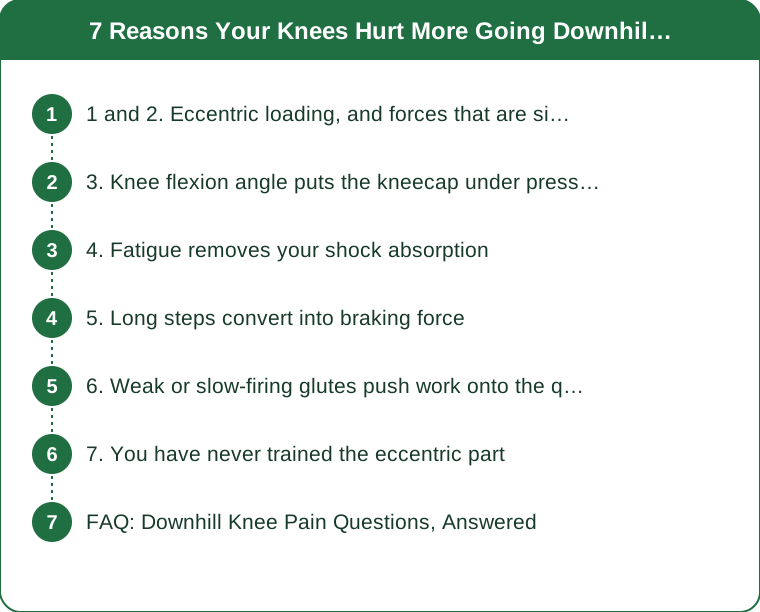
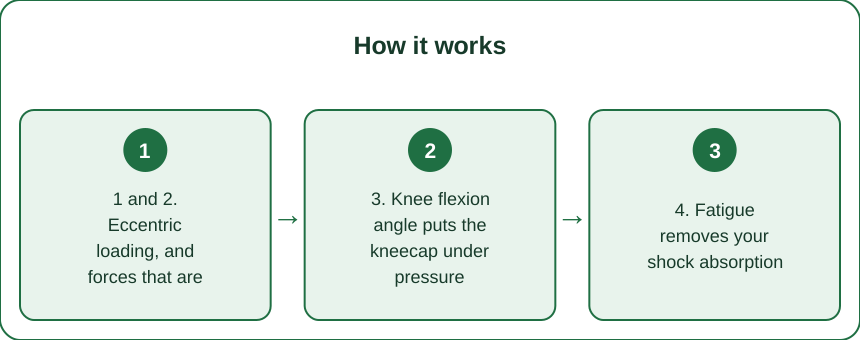
1 and 2. Eccentric loading, and forces that are simply higher
1. Descent is eccentric work
Uphill, your quads shorten as they produce force, which is concentric work. Downhill, they lengthen while resisting, which is eccentric work.
Eccentric contractions produce more force per unit of muscle activation and cause more mechanical stress and muscle damage at the same perceived effort. That combination is why descent feels easier and costs more.
The measurable signature: delayed onset muscle soreness after a hilly hike is overwhelmingly from the downhill portion. Your quads hurt two days later because they spent an hour lengthening under load, not because they spent an hour climbing.
The knee is caught in the middle of this. Every eccentric quad contraction transmits force through the patellar tendon and across the patellofemoral joint.
2. The impact forces are higher
Numbers from gait analysis are consistent on this. Level walking puts roughly 1 to 1.5 times body weight through the knee. Uphill walking pushes that to around 2 to 3 times. Downhill walking reaches 3 to 4 times, and downhill running can go higher.
Grade matters more than most people expect. The difference between a 5 percent and a 15 percent descent is not linear. Steeper means more braking force per step, and braking force is where the load lives.
Practical translation: a long gentle descent and a short steep one are not equivalent even if the elevation loss matches. The steep one costs more per step, and step count is what accumulates.
3. Knee flexion angle puts the kneecap under pressure
Patellofemoral joint compression rises with knee flexion. The deeper the bend, the harder the kneecap is pressed against the femur.
Descending requires more knee flexion than ascending at the moment of loading, because you are lowering your body mass in a controlled way. So you get higher force at a joint angle that already concentrates force.
This is why patellofemoral pain, the ache around or behind the kneecap, is the most common downhill complaint rather than pain on the inside or outside of the joint.
It also explains the stairs pattern. People with downhill knee pain almost always report that descending stairs is worse than ascending, and that is the same mechanism in a compressed form.
4. Fatigue removes your shock absorption
Your quads, glutes, and calves absorb impact by yielding in a controlled way. When they are fatigued, they yield less and the force goes somewhere else, which is bone, cartilage, and connective tissue.
This is the reason downhill pain so often shows up on the way back rather than at the start. The descent at the end of a long day is loading a system that has already spent its capacity.
The pattern to notice:
- Pain that appears in the last third of a hike rather than the first
- Feeling like your legs are landing harder than earlier, with the same terrain
- A sense that you cannot control the descent as precisely
What to do about it in the moment: slow down deliberately before your form degrades rather than after. Losing ten minutes on the descent costs less than three days of knee pain.
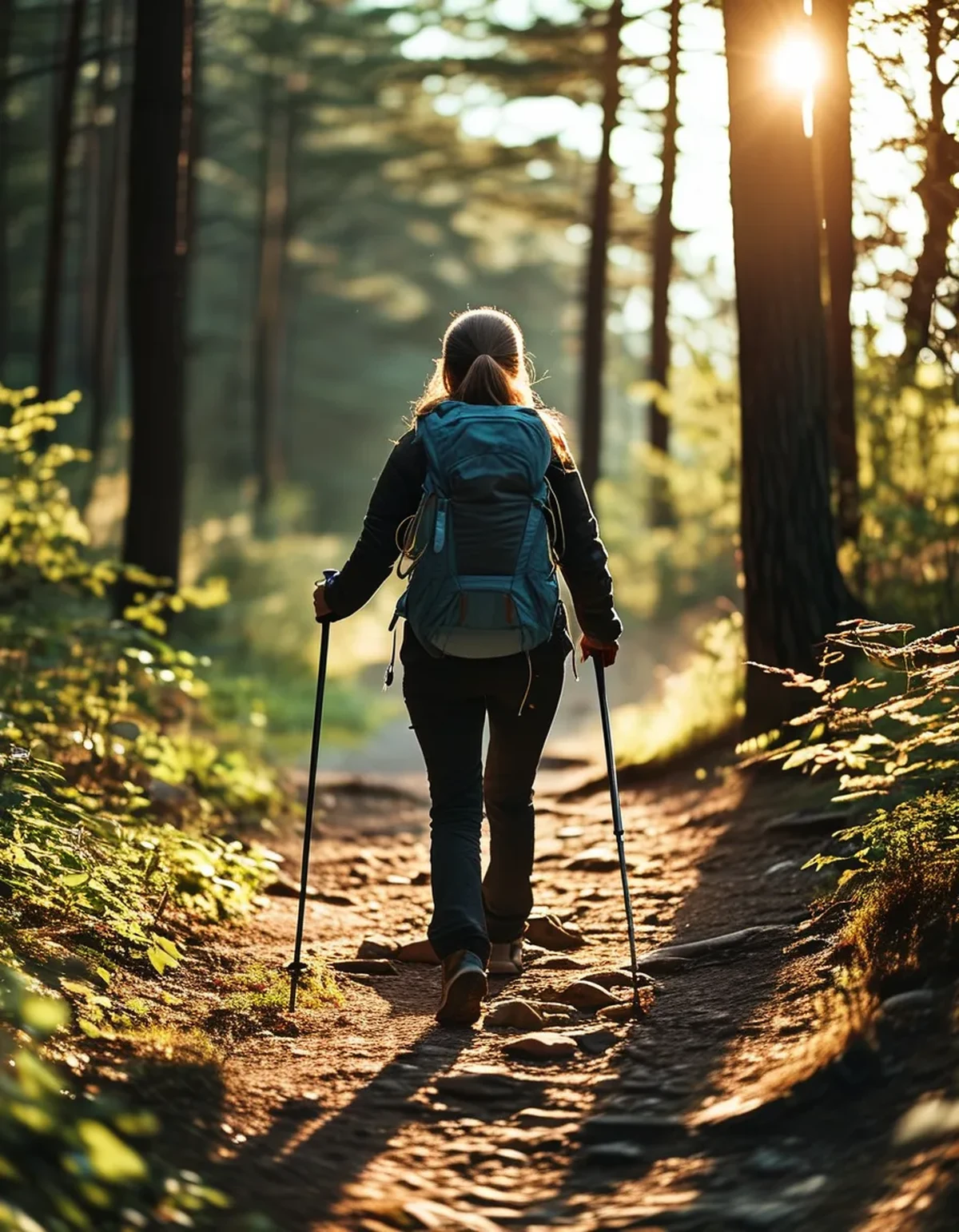
5. Long steps convert into braking force
Reaching your foot far out in front on a descent means landing with a nearly straight leg and a heel strike well ahead of your center of mass. That geometry maximizes braking force and sends it straight up the leg.
Shorter steps at a higher cadence is the single easiest change available. Landing closer to underneath yourself lets the muscles absorb the load rather than the joint.
How to do it: aim for noticeably quicker, smaller steps, letting your feet land closer to your body. It feels less efficient and it is considerably kinder to the knee. On steep sections, small quick steps beat controlled long ones for joint load, even if the long ones feel more graceful.
Zigzagging works on wide trails. Descending diagonally reduces effective grade at the cost of distance, and on a steep section that trade is usually worth it.
6. Weak or slow-firing glutes push work onto the quads
Descent should be shared between hips and knees. When hip extensors are underused, the knee takes a larger share of the braking.
Gluteus medius matters here too, for a different reason. It controls frontal-plane knee position during single-leg loading, and every downhill step is single-leg loading. When it fatigues, the knee drifts inward, which changes patellar tracking and increases pain.
The self-check: film yourself descending a few stairs from the front. If your knee tracks inward over your foot as you lower, that is the pattern.
What helps: lateral band walks, single-leg step-downs, and side-lying hip abduction, two to three times a week. Step-downs are the most directly transferable because they are literally the movement, done slowly.
7. You have never trained the eccentric part
Most training is concentric or mixed. Very little of it is deliberately eccentric, which is why descent capacity lags behind climbing capacity in almost everyone.
The good news is that eccentric capacity adapts quickly, and the adaptation is protective. A few weeks of deliberate eccentric work substantially reduces both soreness and joint load on descents.
A minimal program:
- Slow step-downs: stand on a step, lower one foot toward the floor over 4 seconds, tap, come back up with the other leg doing the work. 3 sets of 8 per leg, twice weekly.
- Slow-tempo split squats: 4 seconds down, normal speed up. 3 sets of 6 to 8 per leg.
- Downhill walking itself, progressively. Start with 10 minutes of moderate descent and build over several weeks. Specificity works.
- Spanish squats or wall sits for patellar tendon tolerance, 3 sets of 30 to 45 seconds.
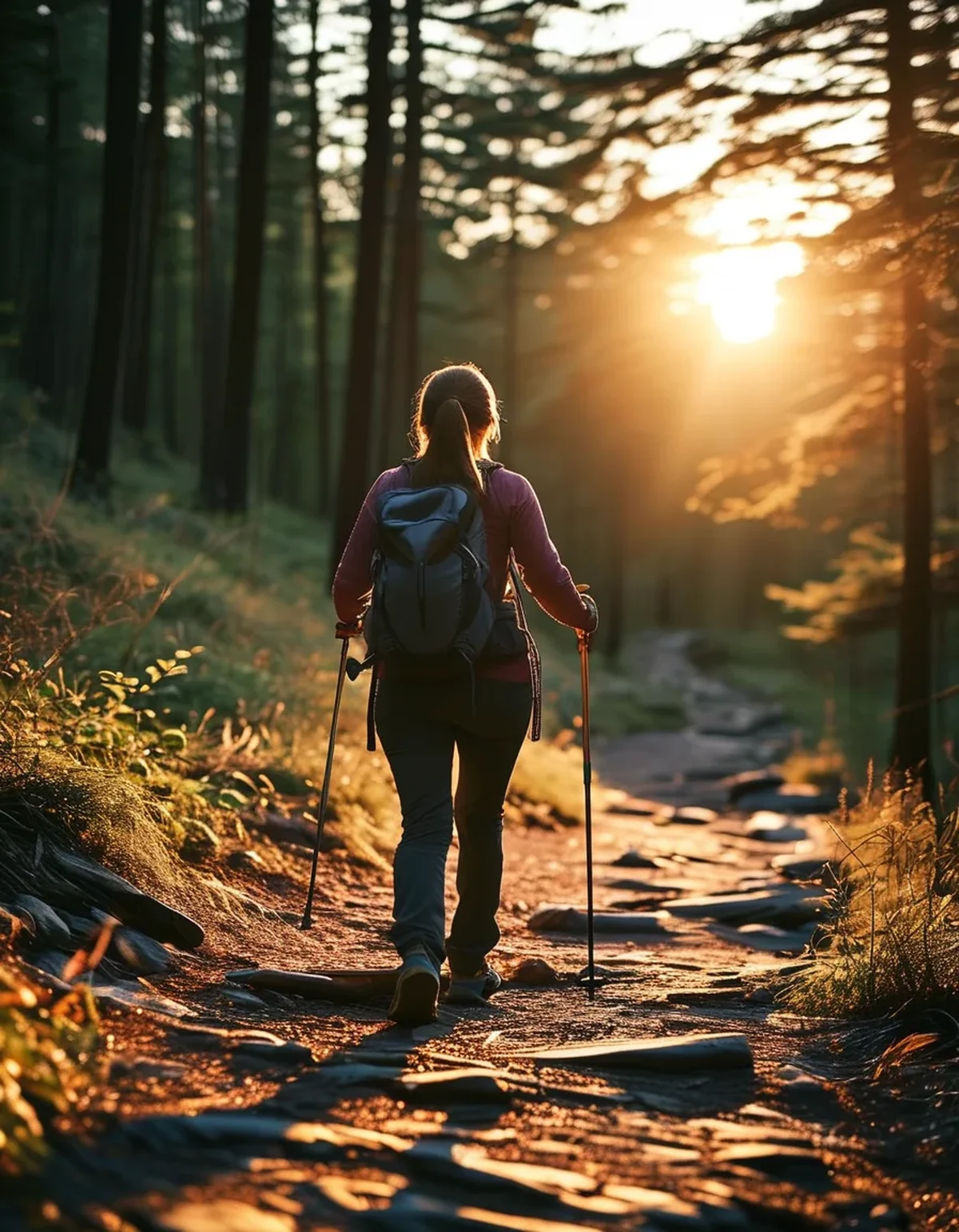
Poles are the immediate fix while you build the capacity. Trekking poles used properly on descent reduce knee load meaningfully, shifting a share to the arms and shoulders. They are the only intervention on this list that works on day one.
Seasonal note: this is peak season for the problem in the northern hemisphere. Trails are dry and fast, days are still long enough for big routes, and fall foliage hikes bring out people whose last long descent was months ago. The combination of untrained eccentric capacity and an ambitious autumn route is the most common cause of a knee that hurts for a week.
This is general information, not medical advice. Swelling, locking, giving way, or pain that persists at rest is worth having assessed rather than training around.
FAQ: Downhill Knee Pain Questions, Answered
Why do my knees hurt going downhill but not uphill?
Descent loads the knee with eccentric quad contractions and impact forces of three to four times body weight, at knee angles that maximize kneecap compression. Uphill is concentric work at lower peak force.
Do trekking poles actually help knee pain on descents?
Yes, and they are the fastest available fix. Used properly they transfer a meaningful share of braking load to the arms and shoulders. Set them longer for descent than for climbing.
How do I train for downhill without hurting my knees?
Slow eccentric step-downs and tempo split squats twice a week, plus progressively longer downhill walks. Eccentric capacity adapts within a few weeks and the adaptation is protective.
TL;DR:
- Descent is eccentric work at three to four times body weight, at knee angles that concentrate pressure on the kneecap. That is the whole story in one line.
- Shorter, quicker steps landing under your body cut braking force more than any technique change.
- Fatigue removes your shock absorption, which is why the pain shows up on the way back rather than the way out.
- Train slow step-downs and tempo split squats twice weekly. Use poles now while that capacity builds.
The uphill tests your lungs and the downhill tests tissue you have probably never trained. Train it, and the descent stops being the price you pay.
Keep Reading
This article is for general informational purposes only and is not medical advice. Always consult a qualified health professional for guidance specific to you.