7 Reasons Your Knees Feel Worse After a Week of Doing Everything Right
Quick Answer: A good week usually means more total load, not less, and knees respond to load changes with a delay of 24 to 72 hours. New rehab exercises create normal delayed soreness, extra walking adds thousands of unaccustomed loading cycles, and better sleep can even make you notice pain you were previously too tired to register. Most good-week flares settle within a week if you hold volume steady rather than pushing or quitting. Sharp pain, swelling or locking is a different conversation.
You did the work. Every single day. And your knees now hurt more than they did during the lazy week before it.
It is one of the most demoralising patterns in knee rehab, and it is common enough that it deserves a proper list rather than a shrug.

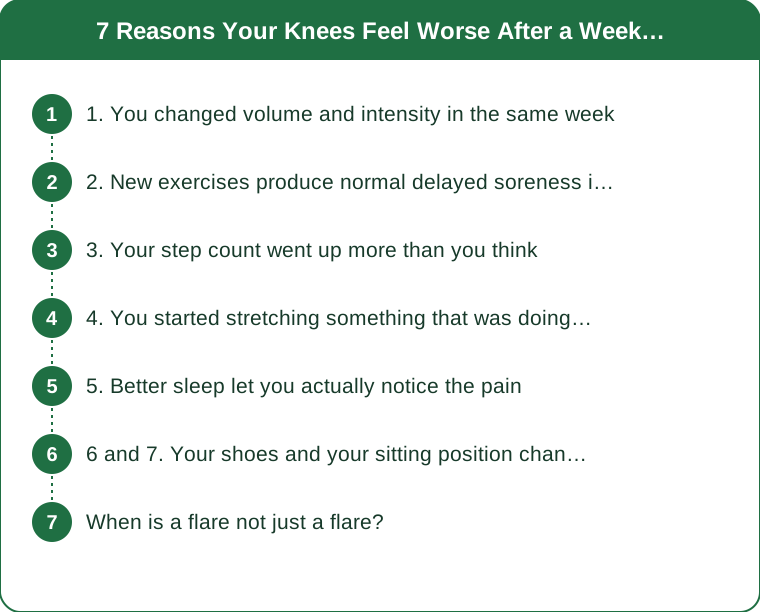
1. You changed volume and intensity in the same week
This is the single most common cause. A good week rarely means one new thing. It means rehab exercises plus more walking plus better posture plus a stretching routine, all starting on Monday.
Each of those is a load change. Together they can easily represent a 40 to 60 percent jump in weekly knee loading, which is well past the roughly 10 percent weekly increase that tissue tolerates comfortably.
The knee is not objecting to the exercises. It is objecting to the arithmetic.
What to do: hold this week at exactly the same volume as last week rather than progressing. If the ache settles by day five to seven, you found your answer.
2. New exercises produce normal delayed soreness in an unfamiliar place
Delayed onset muscle soreness peaks 24 to 72 hours after unfamiliar work, and around the knee it is easy to misread.
Quad soreness above the kneecap, VMO soreness on the inner thigh and soreness where the quad tendon attaches can all feel like joint pain to someone who is already anxious about their knee.
How to tell them apart: muscle soreness is diffuse, tender to press, worse on the first few reps and better as you warm up. Joint irritation is more localised, often worse as activity continues, and frequently accompanied by a warm or puffy feeling.
What to do: if it warms up and improves within the first ten minutes of moving, it is very likely muscular.
3. Your step count went up more than you think
People dramatically underestimate this. Walking 20 extra minutes a day is roughly 2,000 extra steps, which is around 14,000 additional knee loading cycles a week.
At roughly two to three times bodyweight per step on level ground, and considerably more on stairs and hills, that is not a small addition to a joint that has been sensitised.
This one is especially sneaky because walking feels like the gentle option, so people add it without counting it as training.
What to do: check your phone’s step history for last week against the week before. If the jump is over 20 percent, that is your flare, and the fix is to split the walking into two shorter sessions rather than one long one.

4. You started stretching something that was doing a job
Not all tightness is dysfunction. Sometimes a stiff hamstring or a guarded calf is splinting a joint that does not currently feel stable, and aggressively stretching it removes protection before the strength is there to replace it.
Static stretching also temporarily reduces the stiffness of the muscle-tendon unit, and stiffness is what absorbs impact. Stretch hard, then walk 8,000 steps, and the knee takes a slightly bigger share of each step.
What to do: move stretching to the end of the day, after your walking is done, and keep holds to around 30 seconds rather than several minutes. Prioritise strength over length while a knee is irritable.
5. Better sleep let you actually notice the pain
This one sounds like a joke and is not. Sleep deprivation blunts some pain signalling and dominates your attention, so an exhausted week can genuinely mask a knee that has been getting steadily worse.
Sleep well for five nights, remove the fog, and you notice a level of discomfort that was there the whole time.
There is also a less pleasant version: improved sleep often means you are moving more during the day, so the noticing and the loading arrive together.
What to do: this one needs no fix, only recognition. Do not undo the sleep. Rate your pain on the same 0 to 10 scale each morning for two weeks and let the trend tell you the truth rather than the day-to-day noise.
6 and 7. Your shoes and your sitting position changed too
6. Your shoes changed, or your old ones finally died
A motivated week often comes with new shoes, and a new shoe changes heel height, forefoot stiffness and how much your foot pronates. All three change knee mechanics immediately.
The reverse also happens. Shoes lose meaningful midsole cushioning somewhere around 300 to 500 miles, and a week of extra walking can be exactly when a marginal pair crosses that line.
What to do: if new shoes and a new routine started in the same week, take the shoes back out of the equation for a few days. Change one variable at a time, or you will never know which one was talking.
7. You are sitting in a new position without noticing
Better habits sometimes bring worse positions. A standing desk trial, a new chair height, more time on the floor doing rehab exercises, or driving to a gym you did not previously drive to.
Prolonged knee flexion beyond about 90 degrees raises patellofemoral compression significantly, which is why sitting in a low chair or a car often aggravates the front of the knee more than walking does.
The rehab session itself is 15 minutes. The car ride to it might be 40.
What to do: audit the whole day, not the workout. Aim to stand and straighten the knee for 30 seconds every 30 minutes on days when you are sitting more than usual.
When is a flare not just a flare?
Most good-week flares are load-related and settle. Some are not, and these deserve a professional opinion rather than patience:
- Visible swelling that appears within hours, or a knee that feels warm to the touch
- Locking or catching, where the knee genuinely will not straighten
- Giving way under normal walking load
- Sharp, localised pain rather than a diffuse ache
- Pain that wakes you at night or is unrelated to activity
- No improvement at all after two weeks of holding volume steady
Should I stop exercising entirely during a flare?
Usually no. Complete rest deconditions the muscles that protect the joint. Reduce volume by about half rather than dropping to zero, and keep pain-free ranges moving.
How long should a normal flare take to settle?
Three to seven days if you hold steady. Two weeks with no change means it is worth having someone look at it.
Does ice help?
For comfort, yes, and there is no strong evidence it harms recovery. Use it because it feels better, not because it fixes anything.
This is general information, not medical advice. If your knee swells, locks or gives way, see a professional.
TL;DR:
- A good week is usually a big load jump in disguise, often 40 percent or more when you count everything.
- New soreness that warms up and improves is muscular. Localised pain that worsens with activity is not.
- Walking, shoes, sitting position and stretching are all variables people forget to count.
- Hold volume steady for a week rather than pushing or quitting. Most flares settle in three to seven days.
The cruel part of knee rehab is that the week you finally commit is the week your knee complains loudest. That is a timing artifact, not a verdict on the plan. Keep the plan, flatten the curve of how fast you added to it, and give it the week it needs to catch up.
Keep Reading
This article is for general informational purposes only and is not medical advice. Always consult a qualified health professional for guidance specific to you.