7 Reasons Your Knees Feel Worse in Humid Weather
Quick Answer: Humid weather itself does not damage knees, but falling barometric pressure that accompanies humid, stormy conditions may allow slight tissue expansion around the joint, and the behavioural changes that come with humidity - less activity, worse sleep, more sitting, more swelling - account for a large share of what you feel. The evidence for pressure effects is mixed; the evidence for the behavioural chain is much stronger.
Which means most of it is actionable.

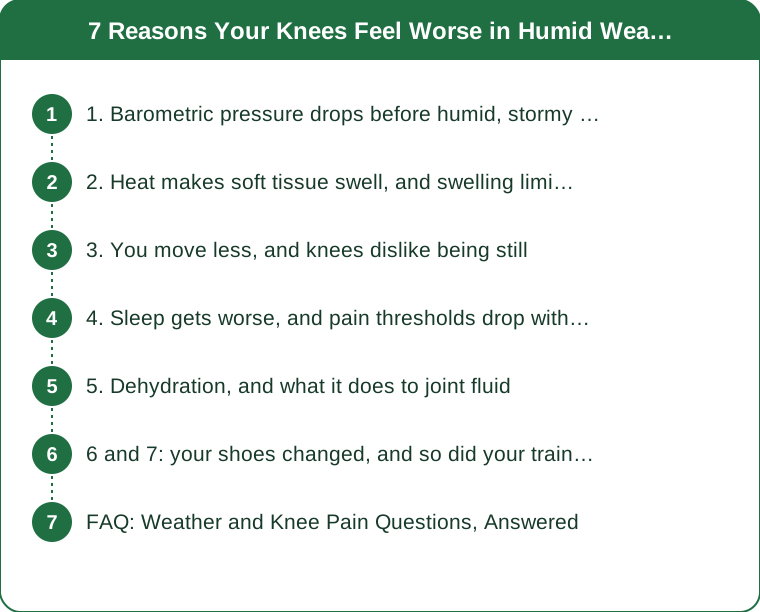
1. Barometric pressure drops before humid, stormy weather
This is the mechanism everyone has heard of, and it is more plausible than proven.
When a humid weather system moves in, barometric pressure typically falls. The theory is that lower external pressure allows tissues around a joint - the capsule, the surrounding soft tissue, any existing inflammation - to expand very slightly. In a joint with existing arthritis or damage, where space is already limited and nerve endings are sensitized, a tiny expansion produces a disproportionate signal.
The research is genuinely mixed. Some large studies have found no meaningful association between weather and joint pain; others, particularly those tracking pressure change rather than absolute pressure, have found modest correlations. The most consistent finding across studies is that the rate of change matters more than the value - a fast pressure drop over several hours is more strongly associated with reported pain than a stable low-pressure day.
What this means practically is that the day before a storm is often worse than the storm itself, and that people who say they can predict weather in their knees are usually predicting a change rather than a condition.
There is nothing you can do about barometric pressure. What you can do is recognize the pattern, so that a bad knee day during a pressure drop does not get interpreted as an injury getting worse.
2. Heat makes soft tissue swell, and swelling limits the joint
Warmth causes blood vessels to dilate, which increases fluid in the surrounding tissue. In a normal joint, that is barely noticeable. In a knee that already has some effusion - fluid inside the joint - it takes up space that was already at a premium.
This is why the sensation is often described as stiffness or tightness rather than sharp pain, and why it is worse late in the day than first thing. Fluid pools with gravity across a day of standing and sitting, and humid heat accelerates it.
You can affect this one directly:
- Elevate for 10 to 15 minutes in the evening, ankles above hip level
- Move every 45 minutes - the calf pump is what clears fluid from the lower leg, and it only works if you use it
- Compression sleeves help a subset of people considerably, particularly if the knee feels full rather than sharp
- Cool showers in the evening reduce vasodilation before bed
If one knee swells and the other does not, that asymmetry is worth mentioning to a clinician rather than attributing to weather.
3. You move less, and knees dislike being still
This is the biggest effect and the least discussed.
Humid weather changes behaviour. Walks get shorter, workouts get skipped, and people spend more of the day indoors and sedentary. Articular cartilage has no blood supply - it is fed by synovial fluid that circulates when the joint moves. A joint that is not moving is a joint that is not being nourished, and stiffness follows within hours, not days.
The self-reinforcing part is what makes it a problem. Knees feel stiff, so you move less, so they get stiffer. By day three of a humid stretch, people are convinced the weather has damaged something when in fact they have simply been sitting for three days.
The intervention is small and specific: a five-minute movement snack every couple of hours. Twenty sit-to-stands from a chair, a slow set of heel raises, a walk to the end of the street. This does not need to be a workout - it needs to be circulation. Indoor options that work on a swampy day include cycling on a stationary bike, swimming if you have access to a pool, or simply walking laps of an air-conditioned building.

4. Sleep gets worse, and pain thresholds drop with it
Humid nights disrupt sleep, and there is strong evidence that poor sleep lowers pain thresholds - the same physical stimulus is reported as more painful after a bad night. This is one of the most reliably replicated findings in pain research, far more so than the weather findings themselves.
So a humid week produces several nights of shallow, interrupted sleep, and by Thursday your knees genuinely hurt more, for reasons that have nothing to do with your knees.
Practical steps, in order of how much they help:
- Cool the bedroom to the mid-60s Fahrenheit if you can. Temperature matters more than humidity for sleep quality.
- Run a dehumidifier rather than only air conditioning if the air is heavy - the perceived comfort difference is substantial.
- Keep a consistent wake time even when the nights are poor. Drifting wake times make the following night worse.
- Avoid alcohol as a sleep aid in hot weather - it fragments sleep and worsens the dehydration issue below.
5. Dehydration, and what it does to joint fluid
In humid heat, sweat does not evaporate efficiently, so you sweat more to achieve the same cooling. Fluid losses are higher than they feel, because the sweat is running off rather than disappearing.
Synovial fluid is largely water. Meaningful dehydration reduces its volume and changes its viscosity, which affects how well the joint surfaces glide. This effect is real but modest - dehydration is not the main driver of knee pain, and drinking more water is not a treatment for arthritis. But mild chronic dehydration across a humid week contributes to the general feeling of stiff, creaky joints, and it also worsens the sleep and fatigue that amplify everything else.
A reasonable target on humid days is to drink enough that urine stays pale, and to include some sodium if you are sweating heavily for hours - plain water in large volumes without electrolytes can leave you worse off. This matters more for people training outdoors than for people sitting in air conditioning.
6 and 7: your shoes changed, and so did your training load
6. Your shoes are different in summer
This one is almost always overlooked and is frequently the actual cause.
Summer footwear is flat sandals, flip-flops, and unsupportive slides. Winter footwear is structured shoes with real midsoles. The transition from supportive to unsupportive footwear changes how force travels up the leg into the knee - flat, thin, flexible soles with no heel counter alter foot mechanics, and the knee absorbs the difference.
Flip-flops in particular change gait measurably: people take shorter steps, grip with their toes, and land differently, all of which shifts load. A summer of daily flip-flop wear is a genuine and underrated contributor to summer knee complaints.
The fix is unglamorous: wear supportive shoes for anything involving real walking distance, and save the flat sandals for short stretches. If your knees hurt more in August than February and you have never questioned your shoes, this is where to look first.
7. Late summer is when training loads jump
There is a seasonal pattern in training. People return from vacation, fall race training begins, gym attendance climbs after the August lull, and school schedules restart routines. Load increases, and the knee complaint arrives two to three weeks later.
Because it coincides with humid weather, the weather gets blamed. But the classic pattern of a training-load knee problem - pain that builds through a session, is worse the day after a hard day, and is concentrated at the front of the knee or the outside of it - looks nothing like a weather effect, which tends to be diffuse, stiff, and present on waking.
How to tell them apart:
- Weather pattern: both knees, diffuse ache, worse on waking and in the evening, unrelated to specific activity
- Load pattern: usually one knee, localized, worse during and after specific activity, improves with a few easy days
That distinction changes what you do. A weather pattern calls for movement, sleep, and patience. A load pattern calls for backing off by 20 to 30 percent for a week and rebuilding more gradually.
When to see someone rather than wait it out: swelling that is visible, a knee that locks or gives way, pain that wakes you at night, or any pain that has not improved after two weeks of sensible modification. This is general information, not medical advice.
FAQ: Weather and Knee Pain Questions, Answered
Is weather-related joint pain real or psychological?
The experience is entirely real. What is uncertain is the mechanism, and how much of it is barometric versus behavioural. Expectation does play some role in reported pain, but that does not make the pain imaginary.
Will moving to a dry climate fix it?
People who move often report improvement for a year or so, then settle back to a similar baseline. Climate change is a large intervention with an unreliable payoff. Managing sleep, load, and activity is cheaper and more predictable.
Does a knee brace help on humid days?
A compression sleeve helps some people, mostly by reducing the sensation of fullness and improving position sense. A rigid brace is for instability, not for weather, and wearing one unnecessarily can weaken the surrounding muscles over time.
Should I stop exercising when my knees ache from the weather?
No - reduce intensity rather than stopping. Low-impact options like cycling, swimming, and elliptical work keep the joint circulating without the load that aggravates it.
Does the humidity itself matter, or just the pressure?
Most studies that separate them find pressure change to be the stronger signal, with humidity and temperature contributing less. But since they arrive together in late summer, the distinction is more academic than practical.
TL;DR:
- Falling barometric pressure ahead of humid weather may allow slight tissue expansion, but the evidence is mixed and the effect is modest.
- Heat-driven swelling, reduced movement, and disrupted sleep account for far more of what you feel, and all three are fixable.
- Move for five minutes every couple of hours - cartilage is fed by movement, not by rest.
- Check your summer shoes. Flat unsupportive sandals change knee loading more than most people realize.
- Late-summer training increases get blamed on weather. One knee and activity-linked pain means load, not barometry.
A humid week is not damaging your knees. The three days of sitting still because of it might be.
Keep Reading
This article is for general informational purposes only and is not medical advice. Always consult a qualified health professional for guidance specific to you.