7 Reasons Your Knees Feel Worse on Rest Days Than Training Days
Quick Answer: Knees frequently feel worse on rest days because cartilage has no blood supply and depends on movement to exchange nutrients and fluid, so prolonged stillness leaves the joint stiff and poorly lubricated. Add delayed onset soreness peaking at 24 to 48 hours, longer periods of sitting with the knee bent, and the absence of the warm-up effect that made training feel fine, and the rest day becomes the day symptoms show up. In most cases the answer is gentle movement rather than more rest.
You trained Saturday and felt strong. Sunday you sat down to watch something, stood up two hours later, and your knees behaved like they belonged to someone thirty years older.

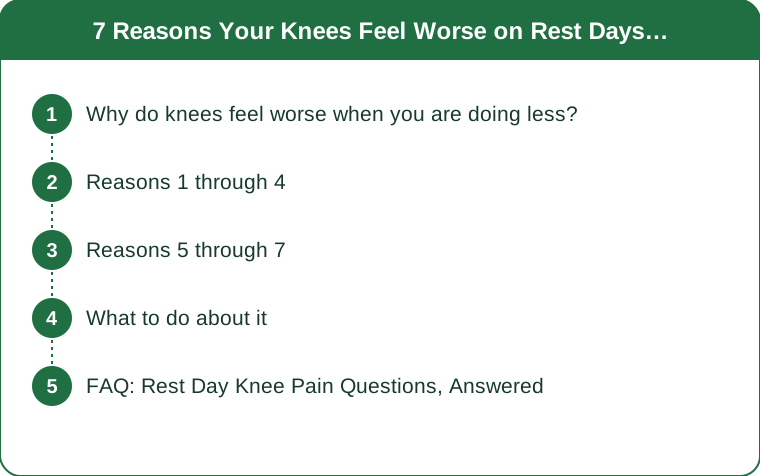
Why do knees feel worse when you are doing less?
It seems backwards, and the explanation sits in how joints are built.
Cartilage has no blood supply. It receives nutrients from synovial fluid, and that fluid moves through the joint mainly when the joint moves. Compression and release act as a pump.
Stillness stops the pump. Two hours in a chair means two hours of minimal fluid exchange, which is why the first few steps afterwards feel thick and creaky and why the sensation eases within a minute or two of walking.
Synovial fluid also thickens when static. It is thixotropic, meaning it becomes less viscous with movement and more viscous at rest. The joint is genuinely better lubricated after ten minutes of walking than it was at minute zero.
Training provides a warm-up you do not get on a rest day. During a session, the joint is warm, the fluid is moving, and the surrounding muscles are active. On the sofa, none of that is happening, so the same knee reports very different sensations.
And the timing of soreness lines up with rest days. Delayed onset muscle soreness peaks around 24 to 48 hours after a hard session, which for most schedules is precisely the rest day. Tight, sore quads change how the kneecap tracks, and that registers as knee pain rather than muscle pain.
The overall shape of it: rest days are not causing damage. They are removing the movement that was masking stiffness, and adding the delayed soreness from the day before.
Reasons 1 through 4
1. Sitting for long stretches with the knee bent
Prolonged flexion increases pressure behind the kneecap and reduces circulation around the joint. This is the mechanism behind what clinicians informally call theatre sign - knee pain after a long film or a long drive. The dose matters more than the position: 30 minutes is fine, three hours is not.
2. Delayed onset soreness peaking on schedule
Muscle soreness from Saturday reaches its worst point on Sunday. Tight quadriceps pull on the kneecap through the patellar tendon and subtly change how it tracks in its groove. The knee is reporting a muscle problem in a joint’s voice.
3. No warm-up effect
On training days, you spend 10 minutes raising joint temperature and moving fluid before anything demanding happens. On rest days, you go from stillness to standing up with no transition, and the joint is at its stiffest exactly when you load it.
4. Inflammation from the previous session catching up
Normal training produces a mild inflammatory response that peaks well after the session ends. It is part of adaptation rather than injury, but it produces swelling and warmth in the joint that you feel most when you are not distracted by activity.

Reasons 5 through 7
5. Different, worse positions on rest days
Rest days involve postures that training days do not - crossed legs, tucked feet on a sofa, kneeling on the floor with a child, sitting on soft furniture that puts the hips below the knees. Several of these load the joint in ways a gym never does, and they are held for hours rather than seconds.
6. Less overall movement across the whole day
A training day usually includes the session plus the walk there, the moving around afterwards, and generally more steps. A rest day can quietly drop from 9,000 steps to 2,000. The joint notices the total, not the workout.
7. Attention
This one is real and frequently dismissed. During training, attention is on the task and the sensation is filtered. On a quiet Sunday, there is nothing competing for attention, so a low-level ache that was present all week finally gets noticed. It does not mean the pain is imaginary; it means the rest day is when you have the bandwidth to register it.
Which of the seven applies to you is usually identifiable. If stiffness eases within a few minutes of moving, reasons 1, 3, and 6 are the likely candidates. If there is genuine soreness in the muscle as well, reason 2. If the knee is warm and puffy, reason 4.
This is general information, not medical advice. Persistent swelling, locking, giving way, or pain that does not ease with movement should be assessed by a professional.
What to do about it
The counterintuitive answer is that rest days generally need more movement, not less.
Break up sitting every 30 to 45 minutes. Stand, walk to the kitchen, do ten slow half-squats. The interval matters far more than the intensity - it is about restarting the fluid pump.
Walk 20 to 30 minutes on rest days. Easy, flat, unhurried. This is the highest-value single intervention for stiff knees and it makes most people feel dramatically better by evening.
Do 10 straight-leg raises and 10 seated knee extensions in the morning. Two minutes total, no equipment. It moves fluid and activates the quadriceps without loading the joint.
Change position rather than finding the perfect one. No sitting posture is good for three hours. Alternating between two mediocre positions beats holding one ideal one.
Use heat rather than ice for stiffness. Stiffness responds to warmth, which increases tissue extensibility and comfort. Save ice for genuine swelling after an acute irritation.
Reconsider active recovery instead of full rest. For many people, a rest day of easy cycling or swimming produces better knees than a rest day of sitting, without compromising recovery from the hard session.
And look at your training day pattern if this repeats weekly. Consistent Sunday knee pain after Saturday training sometimes means Saturday is doing too much in one go, and spreading the same volume over two days resolves it.
FAQ: Rest Day Knee Pain Questions, Answered
Why do my knees hurt more on days I do not exercise?
Because cartilage depends on movement for nutrient exchange and synovial fluid thickens when static. Add delayed soreness peaking 24 to 48 hours after training and long periods of sitting, and the rest day becomes when symptoms surface.
Should I rest more if my knees hurt on rest days?
Usually not. If stiffness eases within a few minutes of walking, the joint is asking for movement rather than more stillness. Persistent swelling or pain that worsens with gentle movement is a different situation and warrants assessment.
Why do my knees hurt after sitting through a film?
Prolonged knee flexion raises pressure behind the kneecap and reduces circulation around the joint. It is common enough to have an informal name - theatre sign - and it resolves with periodic straightening and standing.
Is heat or ice better for stiff knees on a rest day?
Heat, generally. Warmth improves tissue extensibility and comfort in a stiff joint. Ice is more useful for acute swelling after an irritating session than for morning-after stiffness.
How much should I walk on a rest day?
Twenty to thirty easy minutes covers it for most people, ideally broken across the day rather than done in one block. The goal is repeated joint movement, not a training stimulus.
TL;DR:
- Cartilage has no blood supply and depends on movement, so stillness leaves the joint stiff and poorly lubricated.
- Delayed soreness peaks 24 to 48 hours after training - precisely on your rest day.
- Long sitting with bent knees, fewer total steps, and no warm-up effect all stack on the same day.
- Break up sitting every 30 to 45 minutes and walk 20 to 30 easy minutes.
- Heat helps stiffness; save ice for genuine swelling.
If your knees feel better ten minutes into a walk, they were not asking for rest. They were asking to be moved.
Keep Reading
This article is for general informational purposes only and is not medical advice. Always consult a qualified health professional for guidance specific to you.