7 Reasons Your Knees Feel Worse the Week You Switch Shoes
Quick Answer: Changing shoes changes heel drop, stack height, cushioning firmness, outsole grip, and forefoot flexibility all at once - and each of those alters how load reaches the knee. Most new-shoe knee pain is an adaptation problem, not a defect. Transition over two to three weeks, keep the old pair in rotation, and change one variable at a time.
The shoes are better than your old ones by every measure you can name.
And your knees have been complaining since Tuesday, which is not a coincidence and is usually not a reason to send them back.

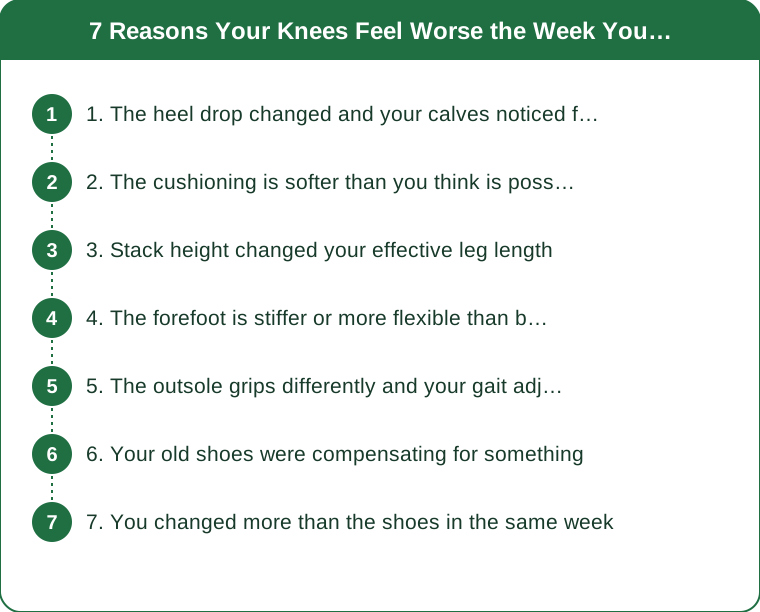
1. The heel drop changed and your calves noticed first
Heel drop is the height difference between heel and forefoot, and it commonly ranges from 0mm to 12mm across models. Dropping from a 10mm shoe to a 4mm one lengthens the calf and Achilles at every step.
That extra demand changes ankle mechanics, and the knee sits directly above the ankle. When ankle range or timing changes, knee loading changes with it.
The pain usually shows up two to four days in, not immediately, which is why people rarely connect it to the shoes.
What to do: transition over two to three weeks rather than switching outright, and treat a drop change of more than about 4mm as a genuine adaptation rather than a preference. Start with roughly a quarter of your weekly walking or running in the new pair and add a quarter each week, keeping the longest session in the old shoes until the final week.
2. The cushioning is softer than you think is possible to overdo
Softer is not automatically kinder to knees. Very soft midsoles compress more under load, which increases ankle instability and can shift work upward to the knee to control it.
Maximal cushioning also alters proprioception - the foot receives less information about the ground, and the corrections that follow are less precise.
Some people genuinely do better in firmer shoes, and the softest option on the wall is not a universal upgrade.
Very soft shoes also mute the feedback your foot uses to place each step, and less accurate placement means the knee spends more of every stride correcting rather than simply absorbing.
What to do: if you moved to a noticeably softer shoe and your knees started complaining, try the same brand’s firmer model before concluding the problem is your knees. Two weeks in a firmer pair is a cheap test and it answers the question definitively.
3. Stack height changed your effective leg length
Higher stack shoes raise you off the ground, which subtly changes the moment arm at the knee and the amount of lateral sway your ankle has to control.
On uneven ground or during turns, a higher platform means more time before your foot is stable, and the knee absorbs part of that delay.
This is most noticeable in trail settings and on cambered pavements, which is where late summer walking and running tends to happen.
Ankle strength decides how well you tolerate it. People with strong, well-conditioned ankles adapt to a high platform quickly; people who have never trained ankle stability feel it at the knee instead, because that is the next joint up the chain.
What to do: keep big stack changes for straight, even surfaces for the first couple of weeks, and save uneven ground for once the shoes feel automatic. Adding two sets of single-leg balance work, 30 seconds each side, three times a week shortens the adaptation noticeably.

4. The forefoot is stiffer or more flexible than before
Forefoot flexibility decides how your foot rolls through the final third of the step. A stiff, rockered forefoot changes toe-off timing significantly, and a very flexible one demands more work from the foot itself.
Either change alters the timing of when knee extension happens, which is the part of the stride where the joint takes most of its load.
Carbon-plated and heavily rockered shoes are the extreme version, and they frequently produce knee or calf complaints in the first fortnight even in experienced runners.
A stiff forefoot can genuinely help some knees by reducing the work at the big toe joint, which is why the same feature that irritates one person suits another. It is not a defect either way.
What to do: limit plated or highly rockered shoes to a portion of your weekly volume rather than making them your daily pair straight away - roughly a third of your weekly sessions for the first month is a reasonable ceiling.
5. The outsole grips differently and your gait adjusted quietly
Grip changes stride length without you deciding to change it. A shoe that slips slightly on a wet path makes you shorten your stride and land more cautiously, which loads the knee differently for the entire session.
The opposite also applies - a very grippy outsole on a smooth surface can cause the foot to stop abruptly, transmitting more rotational force through the knee.
This one is genuinely invisible. Nobody notices they have shortened their stride by 4 percent, and the knees register it clearly.
Late summer conditions make this more likely, since damp mornings and dew on grass change grip substantially compared with the dry July surfaces most people bought their shoes for.
What to do: test new shoes on your usual surfaces, in your usual conditions, before drawing conclusions about how they feel. A shoe judged only on a dry treadmill tells you very little about how it will behave on your actual route.
6. Your old shoes were compensating for something
A worn shoe develops a personalised wear pattern that quietly accommodates your gait - a compressed lateral heel, a flattened medial forefoot. A new pair removes that accommodation overnight.
If you have a mild alignment difference, a leg length discrepancy, or an old injury you no longer think about, the worn shoe may have been managing it.
The new shoe is not causing the problem; it is revealing it. That distinction matters, because the fix is usually strength or an insole rather than a different shoe.
Replacing shoes before they are worn out avoids this entirely, which is one practical argument for rotating two pairs rather than running one into the ground and buying a replacement.
What to do: keep the old pair for a fortnight and alternate. If the knees settle in the old ones every time, the underlying issue is worth assessing properly rather than solved with another purchase.
7. You changed more than the shoes in the same week
New shoes tend to arrive alongside new intentions - a new plan, a longer route, a return after a break, or the start of a season. The shoes then get blamed for a load increase that would have caused the same symptoms in any footwear.
Late August is a classic window for this, because people restart routines as schedules change and new kit is part of the restart.
The 10 percent rule still applies. Increasing weekly volume by more than roughly a tenth is a common enough cause of knee complaints on its own.
What to do: change one thing at a time. New shoes week, then new volume week - not both together.
And know when it is not adaptation: swelling, a knee that gives way, locking, or pain that worsens steadily over two weeks rather than settling is worth a professional assessment rather than another shoe. This is general information, not medical advice.
TL;DR:
- Heel drop, cushioning firmness, stack height, forefoot stiffness, and outsole grip each change how load reaches the knee - and a new pair changes all five at once.
- Softer and higher is not automatically better; both can increase the stability work the knee has to do.
- Your old shoes may have been quietly accommodating an alignment issue that the new pair reveals rather than causes.
- Transition over two to three weeks and keep the old pair in rotation.
- Never change shoes and training volume in the same week.
Swelling, locking, giving way, or pain that steadily worsens over a fortnight needs assessment rather than a different shoe.
Keep Reading
This article is for general informational purposes only and is not medical advice. Always consult a qualified health professional for guidance specific to you.