7 Signs Your Knee Brace Might Be Doing More Harm Than Good
Quick Answer: A knee brace should support recovery, not replace the muscle strength your knee needs to rebuild — signs it’s working against you include growing dependence, skin irritation, reduced range of motion beyond what’s medically necessary, and muscles around the knee visibly weakening rather than strengthening over time. If you notice several of these seven signs, it’s worth reassessing brace use with a professional rather than continuing on habit.
You started wearing a brace to protect your knee, and months later you feel like you can’t train without it. That shift from support to dependence is one of the clearest signs something about your brace approach needs a second look.

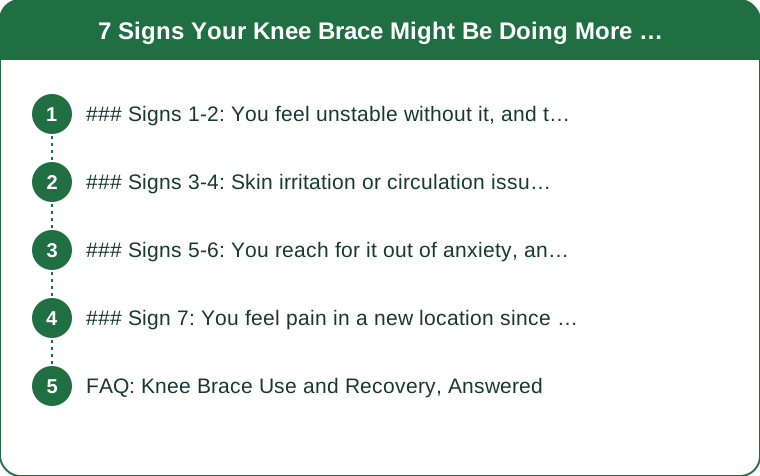
### Signs 1-2: You feel unstable without it, and the muscles around your knee look weaker
If your knee feels noticeably less stable without the brace than it did before you started using one, that’s a sign the brace may be substituting for muscle stability work rather than supporting it — a brace used correctly during rehab shouldn’t leave you weaker unassisted than when you started.
Bracing can also reduce how much the surrounding stabilizing muscles (quadriceps, hamstrings, glutes) are engaged during activity, and prolonged reliance without concurrent strength training can lead to real muscle atrophy around the joint over time — the opposite of what a brace should be supporting toward.
### Signs 3-4: Skin irritation or circulation issues, and range of motion that’s more limited than it should be
A brace that’s the wrong size or worn for too many consecutive hours can cause skin breakdown, pressure marks, or reduced circulation, which are physical warning signs that the fit or wear schedule needs adjustment, not signs to push through.
Some brace designs intentionally limit range of motion during acute injury phases, but continuing that same restriction well past the point your recovery requires it can slow the return of normal joint mobility and delay full functional recovery.

### Signs 5-6: You reach for it out of anxiety, and no one’s reassessed your need for it
If wearing the brace has become more about psychological reassurance than an actual physical support requirement, that’s worth naming honestly — anxiety-driven brace use can mask improving confidence in the joint’s real, current capability and delay a return to normal training.
Brace needs typically change as recovery progresses, and continuing the same protocol without periodic reassessment risks either under-supporting an ongoing issue or over-supporting a knee that’s ready for more independent load.
### Sign 7: You feel pain in a new location since starting to wear it
New pain elsewhere — the opposite knee, hip, or lower back — can indicate the brace is altering your movement pattern in a way that’s shifting strain to a different joint, which is a sign the current setup needs professional reassessment rather than continued use as-is.
FAQ: Knee Brace Use and Recovery, Answered
How do I know when it’s actually time to stop wearing a knee brace?
This should be guided by a physical therapist or doctor based on your specific recovery stage, not a fixed timeline, since needs vary significantly by injury type.
Is it normal to feel some reliance on a brace early in recovery?
Yes, early reliance is expected and appropriate — the concern is reliance that persists or grows well past the acute recovery phase.
Can I wean off a brace gradually rather than stopping all at once?
Yes, gradual reduction in brace-wearing time, paired with progressive strength training, is a commonly recommended approach rather than an abrupt stop. This is general information, not medical advice — work with a professional to guide your specific timeline.
TL;DR:
- A brace should support recovery, not replace the strength work your knee needs to rebuild
- Watch for growing dependence, weakening surrounding muscles, and skin or circulation issues
- New pain in a different location can mean the brace is altering your movement pattern
- Get periodic professional reassessment rather than continuing the same protocol indefinitely
A knee brace that’s working correctly should make itself progressively less necessary — if it’s trending the opposite direction, that pattern is worth addressing sooner rather than later.
Keep Reading
This article is for general informational purposes only and is not medical advice. Always consult a qualified health professional for guidance specific to you.