7 Stair-Climbing Habits That Are Quietly Straining Your Knees
Quick Answer: The most common knee-straining stair habits are landing on locked knees, taking two steps at a time without adjusting stride, leading with the same leg every time, gripping the railing to compensate for weak quads, descending too fast, wearing worn-out shoe soles, and ignoring early twinges instead of adjusting technique — most are fixable without any equipment.
Stairs feel automatic, which is exactly why bad habits inside them go unnoticed for years.

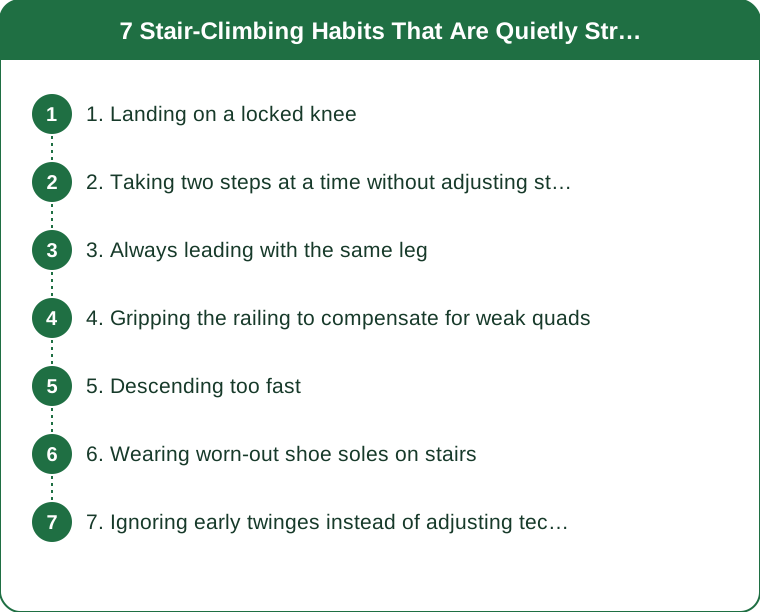
1. Landing on a locked knee
A fully extended, locked knee absorbs impact through the joint itself rather than through the surrounding muscles, concentrating force directly on cartilage and connective tissue with every single step. A slight, consistent knee bend on landing shifts that load into the quads, where it belongs.
2. Taking two steps at a time without adjusting stride
Skipping steps increases the vertical distance your knee has to control on both the push-off and landing, disproportionately increasing joint stress compared to the modest time saved. This habit is especially hard on the knee during descent, where control matters more than power.
3. Always leading with the same leg
Consistently leading with one leg on the way up creates a repetitive, asymmetric loading pattern over thousands of steps a year, which can contribute to muscular imbalance between sides. Alternating which leg leads, when practical, distributes the workload more evenly.

4. Gripping the railing to compensate for weak quads
Relying on arm strength to pull yourself up stairs, rather than leg strength to push, is often a sign of underlying quad weakness being masked rather than addressed — and it means the knee stabilizing muscles never actually get the loading stimulus they need to strengthen.
5. Descending too fast
Descending stairs loads the knee eccentrically — the quads lengthen under tension to control your speed — and this eccentric loading is generally harder on the joint than the concentric loading of climbing up. Rushing down amplifies this load further, which is why knee pain often shows up on descent before it shows up on the way up.
6. Wearing worn-out shoe soles on stairs
Flattened, worn tread reduces shock absorption and grip precision on stair edges, forcing small compensating movements at the knee to maintain balance that a properly cushioned, gripped shoe wouldn’t require.
7. Ignoring early twinges instead of adjusting technique
A mild, occasional twinge on stairs is often the earliest and cheapest signal to fix technique before it becomes a persistent pain pattern — waiting until pain is consistent means addressing both the original habit and an inflamed joint at the same time, instead of just the habit.
TL;DR:
- Land with a slight knee bend, not locked out
- Take stairs one at a time and avoid rushing the descent
- Alternate leading leg and rely on leg strength over railing grip
- Replace worn shoe soles and address early twinges before they become chronic
None of these habits feel dramatic in the moment — the damage is entirely a function of repetition, which also means fixing them pays off just as gradually and reliably.
Keep Reading
This article is for general informational purposes only and is not medical advice. Always consult a qualified health professional for guidance specific to you.