7 Things That Actually Happen to Your Knees After 40 (and What to Do About Each One)
Quick Answer: After 40, cartilage thins gradually, surrounding muscle mass naturally declines without strength work, synovial fluid production slows, and old injuries start resurfacing — all fixable or slowable with targeted strength training, not something to just accept as inevitable.
‘My knees just aren’t what they used to be’ gets said a lot after 40, usually as a resigned shrug. Most of what’s actually happening is specific and, in large part, trainable.

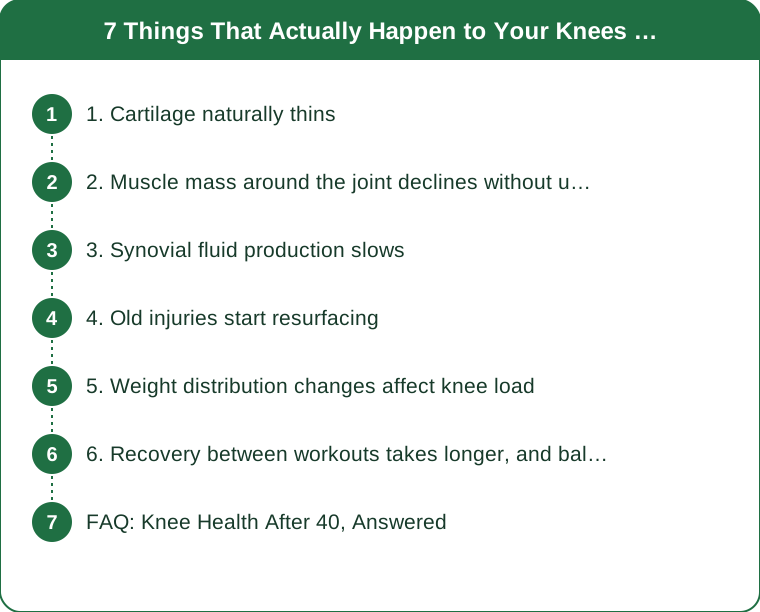
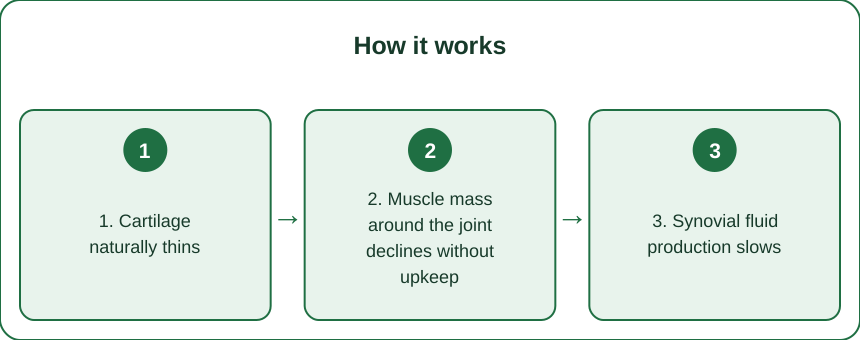
1. Cartilage naturally thins
Cartilage cushioning gradually reduces with age and use, which is normal wear, not automatically a disease process. The counter to it isn’t rest — it’s controlled loading. Moderate resistance training and low-impact cardio actually help maintain joint health better than avoiding movement altogether.
2. Muscle mass around the joint declines without upkeep
Quad and hamstring strength naturally erodes about 1% per year starting in the 30s if untrained. Since those muscles absorb shock that would otherwise hit the knee joint directly, this is the single most preventable factor on this list — 2-3 strength sessions weekly targeting legs slows this dramatically.
3. Synovial fluid production slows
This natural lubricant that keeps joints moving smoothly decreases gradually with age, which is part of why knees can feel stiffer first thing in the morning. A short 5-10 minute warm-up before any activity — even just walking around the house — helps circulate what fluid is available before asking the joint to do real work.
4. Old injuries start resurfacing
A knee injury from your 20s that seemed fully healed can start reasserting itself in your 40s as surrounding tissue changes. If a specific old injury site is the one causing pain now (not general achiness), that’s worth a physical therapy evaluation rather than generic knee exercises.
5. Weight distribution changes affect knee load
Body composition shifts — even modest changes — alter how force distributes through the joint with every step. This isn’t about a number on a scale; it’s about total body strength keeping pace with body weight, which strength training addresses directly.
6. Recovery between workouts takes longer, and balance quietly declines
Recovery: Inflammation resolves more slowly than it did a decade earlier, meaning the same workout now needs an extra rest day to avoid cumulative strain. This is a scheduling fix, not a sign to stop training.
Balance: The nervous system’s sense of joint position subtly weakens with age, increasing awkward-step and misstep risk that can jar the knee. Single-leg balance work for 2 minutes daily measurably improves this within weeks.
FAQ: Knee Health After 40, Answered
Is knee pain after 40 always arthritis?
No — many of the seven factors above cause pain without any arthritis diagnosis. Persistent swelling, locking, or pain that doesn’t improve with rest warrants seeing a doctor rather than assuming arthritis by default.
Should you stop running after 40 to protect your knees?
Not necessarily — runners with strong surrounding muscle often have healthier knees than sedentary non-runners of the same age. The strength training matters more than the activity choice itself.
How fast can you rebuild knee-supporting strength in your 40s?
Measurable strength gains typically appear within 6-8 weeks of consistent training — the muscle absolutely still responds, it just needs the consistent input.
TL;DR:
- Cartilage thinning, slower fluid production, and old injuries are all normal but manageable, not just ‘aging’
- Muscle decline around the knee is the most preventable factor — strength train 2-3x weekly
- Recovery takes longer after 40, so build in an extra rest day, don’t just push through
- Persistent swelling or locking pain still needs a doctor, not just exercise
This is general information, not medical advice — but most of what people chalk up to ‘just getting older’ responds directly to targeted strength work.
Keep Reading
This article is for general informational purposes only and is not medical advice. Always consult a qualified health professional for guidance specific to you.