7 Warm-Up Mistakes That Are Quietly Wrecking Your Knees
Quick Answer: The biggest warm-up mistakes affecting knees are skipping it under time pressure, using only static stretching instead of dynamic movement, jumping straight into heavy loading, ignoring the glutes and hips, and not warming up on cold or cold-weather days — fixing even two or three of these noticeably reduces knee discomfort during workouts.
Knee pain that shows up 10-15 minutes into a workout is rarely about the knee itself. It’s usually a warm-up problem wearing a knee-pain disguise.

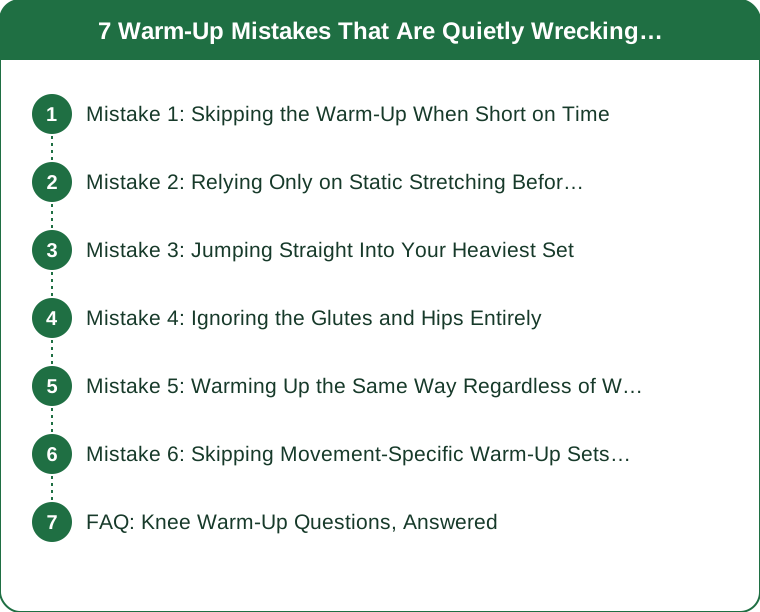
Mistake 1: Skipping the Warm-Up When Short on Time
Cutting the warm-up first when a session runs short is common, but joints and connective tissue need increased blood flow and synovial fluid circulation before handling real load, and skipping this step is one of the most direct paths to knee irritation. A 5-minute abbreviated warm-up is far better than none at all if time is genuinely tight.
Mistake 2: Relying Only on Static Stretching Beforehand
Long static holds before a workout can actually temporarily reduce muscle power output, and they don’t raise heart rate or joint temperature the way dynamic movement does. Leg swings, bodyweight squats, and walking lunges prepare knees for loaded movement far more effectively than holding a quad stretch for 30 seconds.
Mistake 3: Jumping Straight Into Your Heaviest Set
Loading the knee joint heavily before it’s had progressively increasing warm-up sets means the first working set is absorbing more relative stress than a properly ramped-up joint would experience. Two to three light-to-moderate ramp-up sets before your true working weight give the knee time to adapt within the session itself.

Mistake 4: Ignoring the Glutes and Hips Entirely
Weak or under-activated glutes force the knee to compensate for hip instability during squats, lunges, and running, since the hip and knee work as a connected chain, not independently. Adding glute bridges or lateral band walks to your warm-up routine reduces the compensation pattern that often shows up as inner or outer knee pain.
Mistake 5: Warming Up the Same Way Regardless of Weather or Time of Day
Cold weather and early morning sessions both mean starting from a lower baseline joint temperature, and using the exact same 5-minute warm-up regardless of conditions under-prepares the knee on those days specifically. Adding 3-5 extra minutes of gentle movement on cold or early sessions closes this gap.
Mistake 6: Skipping Movement-Specific Warm-Up Sets, or Rushing Because You Feel ‘Already Warm’
A general warm-up (jogging, jumping jacks) raises heart rate but doesn’t necessarily prepare the knee for the specific movement pattern of that day’s workout, whether that’s squatting, running, or lateral movement — a few light reps of the actual planned exercise bridges this gap better than generic cardio alone. And feeling generally warm from walking to the gym or a hot day doesn’t mean the specific joint tissue involved has had adequate preparation, since ambient body temperature and joint-specific readiness aren’t the same thing.
FAQ: Knee Warm-Up Questions, Answered
How long should a proper knee-protective warm-up actually take?
Most effective warm-ups take 8-12 minutes, combining general cardio, dynamic stretching, and movement-specific ramp-up sets.
Does foam rolling before a workout help knee-related warm-up?
It can help with muscle tissue quality and blood flow, but it shouldn’t replace dynamic movement and progressive loading as the core of the warm-up.
Is a longer warm-up needed as you get older?
Generally yes — joint tissue takes somewhat longer to reach optimal readiness with age, so adding a few extra minutes is a reasonable, low-cost adjustment.
TL;DR:
- Skipping warm-ups, relying only on static stretching, and jumping straight to heavy loads all stress knees unnecessarily
- Glute and hip activation directly protects the knee joint during squats and lunges
- Cold weather and early sessions need a slightly longer warm-up than usual
- Movement-specific ramp-up sets prepare the knee better than generic cardio alone
Most knee pain that shows up mid-session isn’t a durability problem — it’s a warm-up gap that a few extra minutes fixes.
Keep Reading
This article is for general informational purposes only and is not medical advice. Always consult a qualified health professional for guidance specific to you.