7 Reasons Your Knee Hurts Specifically When Getting Out of the Car
Quick Answer: Knee pain specifically when exiting a car is usually caused by prolonged deep flexion combined with a rotational twisting motion — the fix is almost always about how you move out of the seat, not a sign of a new injury.
Walking’s fine. Stairs are fine. But getting out of the car? That’s when the knee complains, every single time.

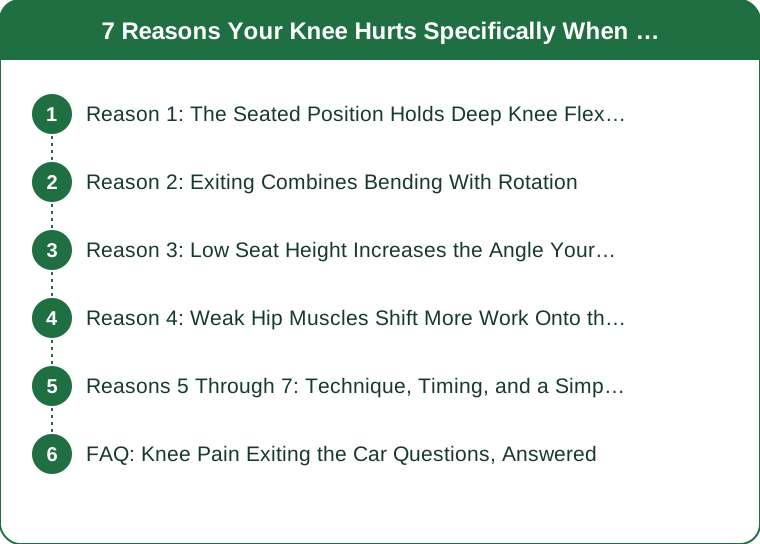
Reason 1: The Seated Position Holds Deep Knee Flexion for a Long Time
Sitting with knees bent for an extended drive puts sustained pressure on the kneecap’s underside, and stiffness built up during that time often shows up the moment you try to move the joint through its full range again.
Reason 2: Exiting Combines Bending With Rotation
Twisting the knee while it’s still under load, which is exactly what swiveling out of a car seat does, stresses the joint differently than straight bending or straightening — this combined motion is a common trigger point for kneecap-related pain specifically.
Reason 3: Low Seat Height Increases the Angle Your Knee Has to Clear
A lower seat height means a deeper knee bend to stand up from it, increasing the load on the kneecap through a larger range — this is part of why the same knee might feel fine getting up from a higher chair.

Reason 4: Weak Hip Muscles Shift More Work Onto the Knee
Underactive glutes and hip muscles mean the knee has to compensate for stability during a semi-twisted standing motion, which is a common but often overlooked contributor to knee pain during this specific movement.
Reasons 5 Through 7: Technique, Timing, and a Simple Fix
Reason 5: Swinging Both Legs Out at Once
Moving both legs out together, then trying to stand, creates an awkward, twisted loading pattern — swinging both feet fully to the ground first, facing forward, before standing reduces the twist significantly.
Reason 6: Standing Up Too Quickly After a Long Drive
Stiffness from sustained sitting needs a moment to ease — standing immediately at full speed doesn’t give the joint time to “warm up” from its seated position.
Reason 7: Not Using the Door or Frame for Support
Using the car door or frame to take some weight off the knee during the stand reduces the joint’s peak load during exactly the moment it’s most vulnerable.
FAQ: Knee Pain Exiting the Car Questions, Answered
Should I be worried this means a serious knee problem?
Not necessarily — this specific pattern (fine walking, painful on this one motion) often points to a positional and technique issue rather than a structural problem, though persistent pain is worth a professional look.
Does adjusting my seat height actually help?
Yes — raising the seat slightly, if your vehicle allows it, reduces the depth of knee flexion needed to exit, which directly addresses one of the biggest contributing factors.
Is this connected to how long I’ve been driving that day?
Often, yes — longer drives mean more prolonged flexion and more stiffness built up by the time you try to exit.
TL;DR:
- The combination of deep flexion and twisting, not walking itself, is what triggers this specific pain
- Swinging both feet to the ground first, facing forward, reduces the twisting load
- Using the door frame for support takes weight off the knee during the vulnerable moment
- A lower seat height and weak hip muscles both make the pattern worse
Small changes to how you exit the car resolve this far more often than the pain suggests. This is general information, not medical advice.
Keep Reading
This article is for general informational purposes only and is not medical advice. Always consult a qualified health professional for guidance specific to you.