Does Running Ruin Your Knees? The Research Answer That Surprises Everyone
The ‘running ruins knees’ warning comes from everyone’s uncle and almost no one’s research — the studies consistently find recreational runners have HEALTHIER knees than sedentary peers — and the real story is about how you run, not whether. The evidence, honestly.

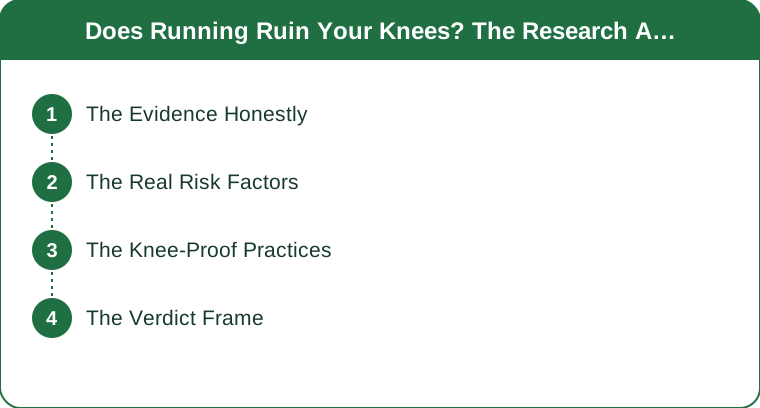
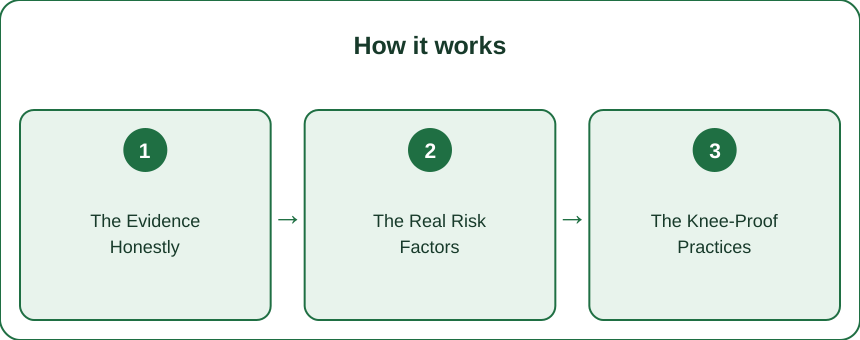
The Evidence Honestly
What the research actually shows: the arthritis surprise (the recreational-runner studies finding LOWER knee-arthritis rates than sedentary controls — the systematic reviews aligning; the loading that cartilage apparently likes in reasonable doses), the cartilage-adaptation science (cartilage responding to cyclical loading like other tissues — the use-it-or-lose-it biology from the motion-is-lotion doctrine; the joint built by movement, not spent by it), the elite-caveat honesty (the very-high-volume competitive tier showing elevated rates — the dose curve that bends at extremes; the recreational-runner reader living nowhere near it), and the sedentary irony (the knee-protective couch strategy associating with WORSE knee outcomes — the avoidance that weakens everything the knee relies on; the uncle’s advice inverted).
The Real Risk Factors
What actually causes runner’s knee pain: the too-much-too-soon champion (the volume spikes behind most running injuries — the 10-percent-rule wisdom and the couch-to-race ambition audit; the c25k gradualism vindicated), the strength deficit (the runner who only runs — the quad-hip weakness from the stairs chapter transferring; the runners-don’t-lift culture as the injury pipeline), the recovery debt (the consecutive hard days and short sleep — the tissue that adapts between runs, not during; the recovery doctrine at running stakes), the previous-injury shadow (the old injury un-rehabbed being the best injury predictor — the comeback chapter’s unfinished business), and the surface-and-shoes footnote (mattering less than folklore claims — the gradual-transition rule for changes; the rotation habit from the shoe chapters as modest insurance).

The Knee-Proof Practices
Running that builds knees: the strength floor (two weekly sessions — the squats, step-downs, hip work and calf raises from the knee-strength chapter; the single change with the biggest injury-rate impact), the volume patience (the weekly mileage grown boringly — the ambitious race deferred a season beating the ambitious rehab), the cadence-and-form note (the modest quicker-steps adjustment reducing knee load in the research — the overstriding fix; the form left otherwise alone per the natural-stride evidence), the surface-variety habit (the trail-road-track rotation as gentle variability), the hard-easy rhythm (the recovery runs kept honestly easy — the polarized structure from the training chapters), and the pain-response protocol (the niggle answered with a down-week, not denial — the whisper-versus-shout hierarchy; the runner who deloads early keeps running; the one who pushes through books the physio).
The Verdict Frame
Running in the knee’s long story: the lifelong-runner evidence (the decades-runners aging with good knees at rates that embarrass the myth — the activity as investment, compounding), the starting-late reassurance (the forties-and-fifties beginners adapting fine on gradual programs — the never-too-late data from the age chapters; the walk-run entry from the c25k path), the arthritis-and-running nuance (the diagnosed-arthritis runner often able to keep running with management — the doctor-guided version; movement remaining medicine even then per the arthritis chapter), the myth-retirement ceremony (the ‘ruining your knees’ comment now answerable with the literature — politely, once, then keep running), and the real moral (the knees ruined by nothing more often than by nothing — the sedentary decade quietly doing what running was blamed for; the miles, sensibly built, being the knee’s friend). Build slowly, lift twice weekly, answer niggles early: the running, knee-approved.
The research says recreational runners have healthier knees than sedentary peers — the real risks are volume spikes, skipped strength work and ignored niggles. Build slowly and lift twice weekly.
Keep Reading
This article is for general informational purposes only and is not medical advice. Always consult a qualified health professional for guidance specific to you.