7 Knee Habits That Quietly Undo Your Strength Work
Quick Answer: Most knee programmes fail on the 23 hours outside the session — sitting positions, footwear changes, downhill loading, skipped single-leg work, and stopping the programme the week the pain does. Fixing these seven habits does more than adding exercises.
You have been doing the rehab. Three times a week, properly, for two months. And the knee is roughly where it was.
The exercises are probably fine. Here are the seven habits most likely to be cancelling them out, in rough order of how much damage they do.

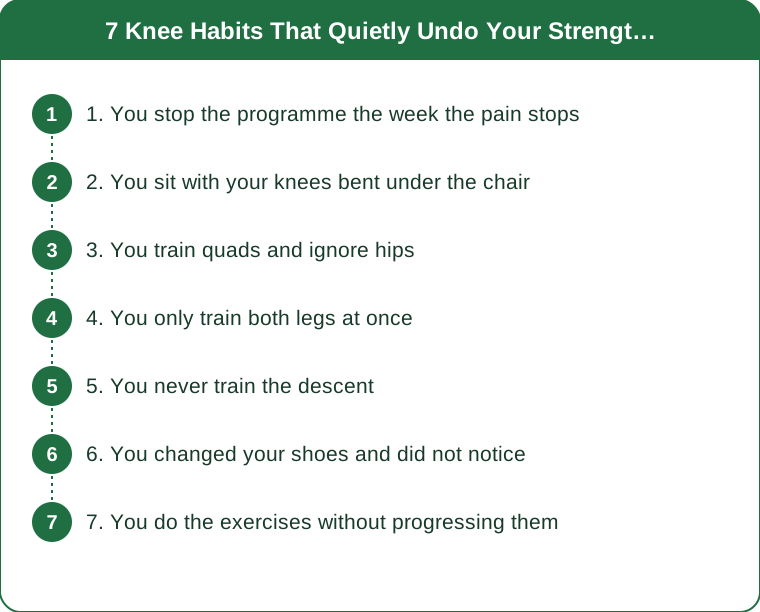
1. You stop the programme the week the pain stops
This is the biggest one, and almost everyone does it.
Pain resolves well before capacity returns. Tendon and muscle adaptation takes roughly three to six months of consistent loading, while symptoms often settle in three to six weeks. Stopping at the symptom point means you built about a fifth of the capacity you needed and then went back to the load that caused the problem.
The pattern is so consistent it is almost predictable: six weeks of diligent work, three weeks of feeling great, then a gradual return of the same symptoms about a month later. People conclude the exercises did not work. The exercises worked and then stopped being done.
The rule: continue for at least eight weeks past the point at which you would happily stop. Then reduce to twice a week as maintenance rather than dropping to nothing. Maintenance volume is small — two sessions of fifteen minutes holds most of what a full programme built.
2. You sit with your knees bent under the chair
The classic desk position — feet tucked back, knees at 100 degrees or more — puts sustained compression through the patellofemoral joint.
Patellofemoral pressure rises with knee flexion angle, and holding a deeply flexed position for hours is the reason so many people’s knees ache most on the days they trained least. The theatre sign — pain after prolonged sitting — is a recognised pattern for exactly this reason.
It gets worse in autumn, when people stop walking at lunch and the sitting blocks get longer.
The fix costs nothing: keep knees at roughly 90 degrees or slightly open, feet flat, and stand up every 30 to 40 minutes. Movement matters more than the perfect angle — a joint that changes position regularly tolerates a mediocre chair far better than a static joint tolerates a perfect one. Set a timer for the first fortnight, because nobody remembers on their own.
3. You train quads and ignore hips
Knee valgus — the knee drifting inward under load — is driven substantially by hip abductor and external rotator strength, not by anything at the knee itself.
If your glute medius cannot control femoral rotation, every squat and every stair step loads the knee at a slightly bad angle regardless of how strong your quads are. You can strengthen a joint enthusiastically in a position that is quietly damaging it.
It also explains why a knee can feel fine in a controlled gym squat and hurt on stairs. Stairs are single-leg, and single-leg tasks expose hip control that a bilateral squat hides completely.
Add lateral band walks, side-lying abduction and single-leg bridges. Twice a week, ten minutes. This is the most commonly missing ingredient in a knee programme, and it is usually the one that produces the fastest change once added.

4. You only train both legs at once
Bilateral exercises let the stronger leg take over, and it will, invisibly.
Force plate studies routinely find double-digit asymmetries in people who feel perfectly even during a barbell squat. Whatever gap exists gets preserved rather than corrected, and the weaker side keeps taking a disproportionate share of the load in single-leg tasks like stairs and walking.
The asymmetry is often on the previously injured side, sometimes from an injury years ago that everyone considers resolved.
Include split squats, step-ups and single-leg RDLs. Always start the weaker side, and match its rep count on both rather than pushing the strong side to its own limit. This one change surfaces problems nothing else will, and it is uncomfortable precisely because it is informative.
5. You never train the descent
Going downstairs hurts more than going up because eccentric loading — the muscle lengthening under tension — produces higher forces than concentric.
Most programmes are built around lifting, pushing and standing up. Very few train controlled lowering. If your knee hurts on descent, the descent is the thing to train, cautiously and deliberately.
Eccentric loading is also what walking downhill, descending stairs and decelerating in sport all demand, so untrained descent is a gap that shows up constantly in daily life.
Slow step-downs from a low box, three seconds down, are the entry point. Start with a step height you can control perfectly — often lower than ego suggests — and progress the height rather than adding weight. Watch the knee track over the middle of the foot rather than drifting inward on the way down.
6. You changed your shoes and did not notice
New trainers, a switch from summer sandals to autumn boots, or a worn-out pair passing its useful life all change the load path through the knee.
Heel height alters knee flexion angle during gait. Cushioning changes impact rate. A worn shoe with collapsed medial support allows more foot pronation, which increases tibial internal rotation and adds to valgus stress. This is a genuinely common cause of a knee that gets worse for no apparent reason in September, when everyone’s footwear changes at once.
Running shoes have a useful life measured in hundreds of kilometres rather than in how they look, and a shoe that appears fine can have lost most of its midsole function.
If the timeline of your flare-up matches a footwear change, that is not a coincidence worth dismissing. Write down the date you started any new pair, which makes this obvious in hindsight rather than mysterious.
7. You do the exercises without progressing them
Two months of the same three sets of twelve with the same red band is maintenance, not rehabilitation.
Tissue adapts to load and then stops adapting. A programme that does not get harder stops working after roughly four to six weeks, which is precisely the point at which most people conclude that rehab does not work for them.
Progression does not have to mean heavier. A red band to a black band, twelve reps to fifteen, a two-second lower to a four-second lower, or a stable surface to an unstable one all count.
Progress something every two weeks: reps, sets, load, range, tempo or stability. Write it down, because the whole problem is that gradual progression is invisible without a record, and memory reliably reports that you have been progressing when you have not.
If pain is sharp, swelling appears, or the knee gives way, that is a signal to get it assessed rather than progressed. This is general information, not medical advice.
TL;DR:
- Keep going for eight weeks past the point pain stops — symptoms resolve long before capacity does.
- Sitting position and footwear changes account for more flare-ups than training errors do.
- Hip strength and single-leg work are the two most commonly missing pieces of a knee programme.
- Train the descent specifically, and progress something every fortnight or the programme stalls.
Pick the two habits above that describe you most accurately and fix only those for a month. Trying to correct all seven at once is how the whole thing gets abandoned by week three.
Keep Reading
This article is for general informational purposes only and is not medical advice. Always consult a qualified health professional for guidance specific to you.