7 Things That Change in Your Knees After 35 — and What to Do About Each
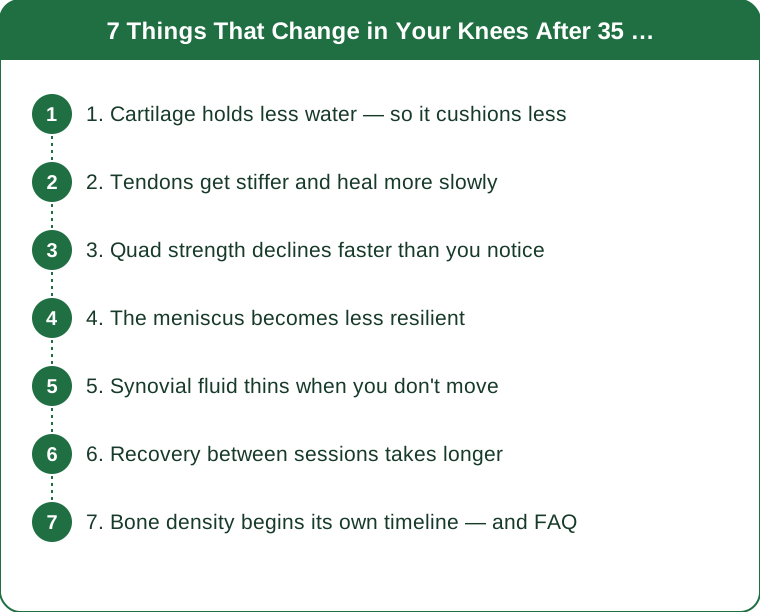
Quick Answer: Seven changes matter: cartilage hydration drops, tendons stiffen and heal slower, quad strength declines faster than you notice, the meniscus becomes less resilient, synovial fluid thins with inactivity, bone density starts shifting, and recovery time between sessions lengthens. The single highest-value response to almost all of them is the same — maintain quadriceps strength and keep moving daily. Most knee decline after 35 is disuse compounding, not inevitable wear.
Something shifts around your mid-thirties. Stairs register differently, kneeling has an opinion, and the knee that never spoke up now comments occasionally. Here’s what’s actually happening, one item at a time.

1. Cartilage holds less water — so it cushions less
Articular cartilage is mostly water, and that water content declines with age.
Cartilage has no blood supply. It gets nutrients through movement — compression pushes fluid out, decompression draws it back in with nutrients. This is why sitting still all day is genuinely bad for cartilage in a mechanical sense.
Lower water content means less shock absorption, which is part of why impact registers more.
What to do: move frequently rather than intensely. Getting up every 30 to 45 minutes does more for cartilage nutrition than one hard session. A short walk, a few squats, standing up during calls.
Cycling and swimming are excellent here — cyclical loading without high impact is close to ideal for cartilage health.
2. Tendons get stiffer and heal more slowly
Tendon collagen turnover slows considerably with age, and the tissue becomes stiffer and less elastic.
Practically: patellar and quadriceps tendon irritation becomes more common, and it takes longer to settle. A tendon issue that resolved in three weeks at 25 can take three months at 45.
Tendons respond to slow, heavy loading — this is well established. Isometric holds and slow controlled resistance work build tendon capacity in a way that stretching does not.
What to do: add slow tempo work. Three-second lowering on squats and step-downs, plus 30 to 45 second isometric holds — a wall sit, or holding the bottom of a split squat.
Warm up longer than you used to. Stiffer tissue needs more preparation. Ten minutes of progressive movement before loading, not two.
3. Quad strength declines faster than you notice
Muscle mass declines gradually from around your thirties without resistance training, and the quadriceps are heavily implicated in knee health.
The quads are the primary shock absorber for the knee. Weak quads mean more force reaching the joint itself with every step down.
Decline is silent because daily life doesn’t demand much. You lose capacity without ever noticing until something specific — a long descent, a heavy day — exposes it.
What to do: train legs against resistance twice a week. Not walking, not cycling — resistance. Squats, split squats, step-downs, leg press, loaded carries.
Test it: single-leg sit-to-stand from a normal chair. If you can’t do it on each side, that’s the highest-priority item on this entire list.

4. The meniscus becomes less resilient
Meniscal tissue loses water and elasticity, and its blood supply — never great — diminishes further.
Degenerative meniscal changes are extremely common on imaging after 40, frequently in people with no symptoms at all. This matters: a scan finding is not automatically your pain source.
What changes practically is tolerance for deep twisting under load. Deep squatting with rotation, pivoting sports, and sudden direction changes carry more risk than they did.
What to do: don’t avoid loading — avoid uncontrolled twisting under load. Squats are fine and beneficial. Squatting deep while turning to grab something is the pattern that causes trouble.
If you play pivoting sports, train the deceleration and cutting patterns deliberately rather than only encountering them at full speed in games.
5. Synovial fluid thins when you don’t move
Synovial fluid lubricates the joint, and its viscosity and volume respond to movement.
This is the mechanism behind morning stiffness and the stiffness after sitting through a long meeting — the fluid hasn’t been circulated.
It’s also why the first few minutes of activity feel worse than the next twenty. You’re distributing fluid.
What to do: a two-minute movement snack every hour. Ten bodyweight squats, or just walking to another room. This is genuinely more valuable for joint comfort than a single long session that bookends eight hours of sitting.
Morning routine matters more after 35. Five minutes of easy knee flexion and extension before you ask anything of them removes most morning stiffness complaints.
6. Recovery between sessions takes longer
This is real, measurable, and the one people fight hardest.
Muscle protein synthesis response, inflammatory clearance, and tissue repair all slow with age. The 48-hour turnaround that worked at 25 often needs 72 at 45.
Training through inadequate recovery is the mechanism behind most mid-life overuse injuries. It isn’t that the training was too hard — it’s that it was repeated too soon.
What to do: adjust frequency, not intensity. You can still train heavy. You may need an extra day between hard leg sessions.
Protein intake matters more, not less. Older muscle is less responsive to a given protein dose, so adequate intake — roughly 1.6g per kg bodyweight for people training — becomes more important.
Sleep is the recovery variable with the largest effect and the one most often traded away.
7. Bone density begins its own timeline — and FAQ
Bone mineral density typically peaks around age 30 and gradually declines, accelerating around menopause for women.
Bone responds to loading. Impact and resistance training stimulate bone maintenance; swimming and cycling, for all their joint-friendliness, don’t provide that stimulus.
What to do: keep some impact in your week if your joints tolerate it. Walking, hiking, or light jumping. Plus resistance training, which loads bone through muscular tension.
The tension to manage: joint comfort favors low impact, bone health favors some impact. The answer is usually a mix — most low-impact work, with a small deliberate dose of impact.
Does knee cracking mean damage?
Usually not. Painless clicking and popping — crepitus — is extremely common and generally not associated with joint damage. Noise with pain, swelling, or catching is a different signal and deserves assessment.
Should I stop running after 35?
No, unless something specific tells you to. Recreational running is not associated with higher rates of knee osteoarthritis in the research, and is often associated with lower rates than sedentary living. Sudden increases in volume are the actual risk factor.
Are squats bad for aging knees?
Well-executed squats within a comfortable range are among the better things you can do for knee health, largely because of what they do for the quadriceps. Pain during or after is a reason to change depth or load, not to stop.
What’s the single most valuable thing?
Quadriceps strength, trained against resistance, twice a week. If you do one thing from this entire list, that’s it.
This is general information, not medical advice. Persistent knee pain, swelling, locking, or giving way deserves evaluation.
TL;DR: Seven changes, and most of them respond to the same two things.
- Cartilage holds less water and feeds through movement — move every 30 to 45 minutes.
- Tendons stiffen and heal slower — add slow tempo work and isometric holds, warm up longer.
- Quad strength declines silently. Resistance training twice a week. Test with a single-leg sit-to-stand.
- The meniscus is less resilient — keep loading, avoid uncontrolled twisting under load.
- Synovial fluid needs circulating. Two-minute movement snacks beat one long session after eight hours sitting.
- Recovery needs more days, not less intensity. Protein and sleep matter more now.
- Bone needs some impact — mix mostly low-impact work with a deliberate small dose.
Most knee decline after 35 is disuse compounding, not inevitable wear. The joint responds to being used well at any age.
Keep Reading
This article is for general informational purposes only and is not medical advice. Always consult a qualified health professional for guidance specific to you.