Why Going Downstairs Hurts Your Knees More Than Going Up
Quick Answer: Descending stairs hurts more than climbing because going down loads the kneecap joint with roughly three and a half times body weight - noticeably more than going up - while the quadriceps work eccentrically, lengthening under load to act as your brakes. Weak braking strength means the force lands on the joint instead of the muscle. That is why pain going downstairs is usually a strength and control problem rather than pure damage, and why eccentric quad training - slow sit-to-stands, step-downs, downhill practice - is the fix that shows results within weeks.
Up is cardio. Down is the part where you grip the handrail and turn slightly sideways like the staircase owes you money. There is a real mechanical reason for that.

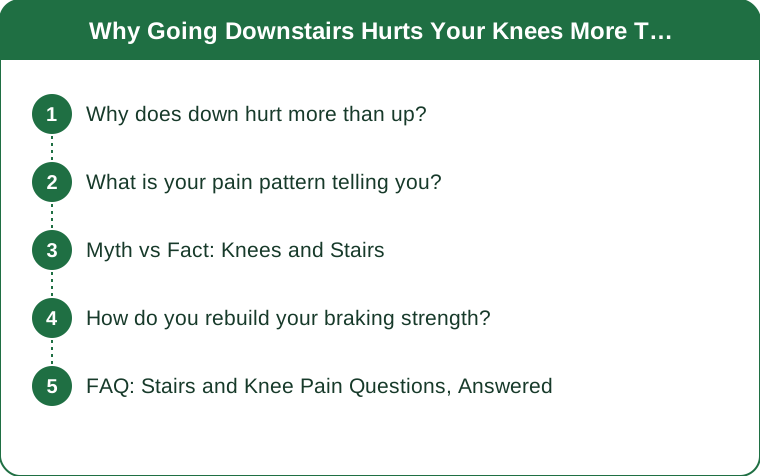
Why does down hurt more than up?
It feels backwards - descending is easier for your heart and lungs - but the knee experiences the opposite.
Going down means braking a falling body. Each descending step is a controlled fall. Your front leg has to catch your entire body weight plus downward momentum, and the knee is the joint doing most of the catching.
The kneecap takes the bill. Stair descent loads the patellofemoral joint - the kneecap against the thigh bone - at around three and a half times body weight, higher than stair climbing. For a 150-pound person, that is over 500 pounds of compression behind the kneecap, step after step.
The quads are working eccentrically. On the way up, thigh muscles shorten as they lift you - the kind of strength most training builds. On the way down, they lengthen while producing force, acting as brakes. Eccentric strength is trained far less, so it is usually the weaker capacity.
Weak brakes shift load to the joint. When the muscle cannot absorb the descent smoothly, the landing gets harder and less controlled, and the joint surfaces and tendon take up the difference. That is the sharp or grinding sensation at the front of the knee.
Small control errors get amplified. A knee that dives inward or a hip that drops on descent changes how the kneecap tracks in its groove under those multiplied loads. An alignment quirk that is silent on flat ground announces itself on stairs.
The encouraging flip side: because the problem is largely about braking capacity, it responds to training - often faster than people expect.
What is your pain pattern telling you?
Descent pain has a few common signatures, and they point in different directions.
Pain around or behind the kneecap - the most common. An ache or sharpness at the front of the knee on descent, often with stiffness after sitting. This is the patellofemoral pattern, and it is the one that responds best to the eccentric strength work in the next section.
A sharp catch on the inner or outer joint line, sometimes with clicking or a sense of the knee locking, suggests the load is catching a sensitive structure inside the joint. Worth a professional look rather than a training-only approach, especially if it started after a twist.
Pain just below the kneecap at the tendon, worse on stairs and jumping, points at the patellar tendon - a load-management story where both too much and too little activity keep it grumpy.
Giving-way or true buckling is a control and strength red flag that deserves assessment before you self-treat with stair drills.
Morning-stiff, better-with-movement aching in the over-50 crowd often reflects joint surface changes - and still improves meaningfully with the same strength work, which surprises people.
Two useful home tests: a single-leg sit-to-stand from a chair, and a slow 8-inch step-down watched in a mirror. If the painful side wobbles, dives inward, or drops fast, you have found trainable weakness rather than mysterious damage.
This is general information, not medical advice. Swelling, locking, giving way, night pain, or pain after trauma should be assessed by a professional.

Myth vs Fact: Knees and Stairs
Myth: Pain going downstairs means your knees are worn out. Fact: Descent pain most often reflects insufficient eccentric quad strength for the braking demand - a capacity problem, not proof of damage. Plenty of people with creaky-looking scans descend painlessly because their muscles absorb the load.
Myth: You should avoid stairs until the pain is gone. Fact: Total avoidance lets braking strength decline further, making the eventual return worse. The winning move is adjusting the dose - fewer flights, slower descent, handrail use - while you rebuild strength, not elimination.
Myth: Going down sideways is just an old-person habit. Fact: It is a legitimate short-term strategy. Turning sideways reduces the depth of knee bend on each step and recruits the hip more, genuinely lowering kneecap load while you strengthen. It is a bridge, not a destination.
Myth: Knee cracking on stairs means damage is happening. Fact: Painless noise is common and poorly correlated with harm. Noise plus pain plus swelling is a different story worth assessing.
Myth: Cushioned shoes will fix it. Fact: Footwear tweaks the sensation slightly, but no midsole absorbs three and a half times body weight of joint compression. Supportive sneakers help comfort; the quads are the actual shock absorbers.
Myth: If squats do not hurt, stairs should not. Fact: Different demands. A controlled two-leg squat is concentric-dominant and symmetric; stair descent is single-leg, eccentric, and repetitive. You can be squat-strong and descent-weak - many people are exactly that.
How do you rebuild your braking strength?
The theme is eccentric loading: slow lowering, then progress. Expect meaningful change in three to six weeks.
Stage 1 - slow sit-to-stands. From a firm chair, stand up normally, then lower over a full three to five seconds. Two legs down at first; progress toward lowering with more weight on the sore-side leg. Two or three sets of eight, most days.
Stage 2 - step-downs. From a low step - start 4 inches - stand on the affected leg and lower the other heel slowly toward the floor, tap, return. The knee tracks over the toes without diving inward; use a mirror. Build to three sets of ten, then raise the step height before adding speed.
Stage 3 - loaded and real-world. Slow bodyweight squats to a box, carrying load on step-downs, then actual staircases taken deliberately: control down, brisk up. Downhill walking is the graduation exercise - it is pure eccentric quad work in disguise.
Add the hip. Side-lying leg raises and banded side-steps train the muscles that stop the knee collapsing inward on descent. Alignment work multiplies the value of the strength work.
Manage the meantime. Handrail without shame, sideways descent on bad days, and lead with the stronger leg going down - down with the sound leg first loads the sore side less. Compression leggings or a light knee sleeve can make descent feel more secure while capacity rebuilds; they are comfort tools, not cures.
Dose by next-day report. A little discomfort during training that settles by the next morning is acceptable; pain that escalates day over day means drop a stage for a week.
FAQ: Stairs and Knee Pain Questions, Answered
Why do my knees hurt going down stairs but not up?
Descent loads the kneecap joint at roughly three and a half times body weight while the quads brake eccentrically - a capacity most people have never trained. Climbing uses the stronger, shortening contraction at lower kneecap load, so it stays comfortable longer.
Is it bad to keep using stairs with knee pain?
Usually the answer is modify rather than avoid: handrail, slower pace, sideways technique on flare days, fewer flights. Complete avoidance erodes the very strength you need back. Sharp worsening pain, swelling, or instability is the signal to get assessed instead.
How long until eccentric exercises help?
Most people notice easier descent within three to six weeks of consistent slow sit-to-stands and step-downs. Tendon-dominant pain can take longer - improvement tends to arrive in a stubborn, gradual way rather than overnight.
Should I lead with my good leg or bad leg on stairs?
Up with the stronger leg first, down with the stronger leg staying on the upper step - the classic cue is up with the good, down with the bad in front. It keeps the heavier braking job on the stronger side while you rebuild.
Do knee sleeves help with stair pain?
A light sleeve or compression leggings can improve the sense of security and warmth, which genuinely helps some people descend more smoothly. They support the process; the strength work does the fixing.
TL;DR:
- Going down loads the kneecap at about three and a half times body weight while the quads brake by lengthening - the least-trained strength most people have.
- Descent pain is usually a braking-capacity problem, not proof of worn-out joints.
- Rebuild with eccentrics: slow sit-to-stands, then step-downs, then deliberate real stairs and downhill walks.
- Train the hips too, so the knee stops diving inward under load.
- Meanwhile: handrail, sideways on bad days, stronger leg doing the braking.
The staircase is not the enemy - it is the most honest strength test in your house, and it is very trainable.
See It in Motion
Seen here: High Waist Yoga Leggings with Inner Pocket — shop it on bubblelime.com
Keep Reading
This article is for general informational purposes only and is not medical advice. Always consult a qualified health professional for guidance specific to you.