Why Knees Click and Pop Constantly and When That Sound Actually Means Something
Quick Answer: Knee clicking on its own almost never means damage — it’s usually gas bubbles releasing in joint fluid or a tendon sliding over a bony bump. The sound isn’t the information. What accompanies it is: new pain, visible swelling, or a feeling of instability. Those three, or a clear change after an injury, are what warrant a check.
Squat, click. Stairs, click. Standing up from the sofa, a pop loud enough that someone in the next room comments.
The question everyone actually wants answered isn’t “why does it click.” It’s “do I need to do something about this?”
This is general information, not medical advice.

Why Do Knees Click So Much?
Two benign mechanisms cover the overwhelming majority.
Gas bubbles in synovial fluid. Joints are filled with fluid containing dissolved gases. Pressure changes during movement allow bubbles to form and collapse, producing a pop. This is essentially the same process as cracking a knuckle — and notably, it can’t repeat immediately, which is why a joint that just popped won’t pop again for a while.
Tendons and ligaments moving over bony prominences. As you bend and straighten, soft tissue slides across bone. Catch, release, click. Purely mechanical. This is the one that repeats endlessly, because nothing has to reset — which is why the every-single-stair clicking is usually this mechanism rather than the first.
That distinction is actually a useful clue for yourself: an occasional loud pop is more likely the gas mechanism; consistent clicking on every repetition is more likely tendon movement. Both are benign.
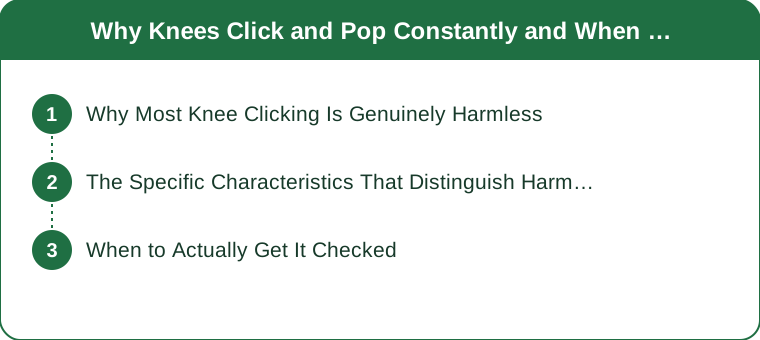
What Distinguishes a Harmless Sound From a Concerning One?
Not the sound. This is the single most important reframe here, so it’s worth stating flatly: volume, frequency, and how unpleasant it sounds carry essentially no diagnostic information. A dramatic crack can be entirely benign. A quiet click accompanied by pain matters more.
What distinguishes them is what comes with the noise:
| Pattern | What it suggests |
|---|---|
| Clicking, no pain, no swelling, no instability | Consistent with benign mechanisms |
| Clicking plus new pain at the same movement | Worth evaluation |
| Clicking plus visible swelling | Worth evaluation |
| Clicking plus knee feeling like it may give way | Worth evaluation |
| A longstanding pattern that changed noticeably | Worth evaluation, especially post-injury |
Pain, swelling, instability, or change. That’s the whole list, and each of them alone is enough reason to book an appointment.
Two additions worth knowing: locking — the knee getting genuinely stuck and needing to be worked free — and an inability to fully straighten the joint. Neither is about sound, and both deserve prompt attention.

5 Mistakes Everyone Makes About Clicking Knees
- Treating volume as severity. Loudness reflects anatomy, not damage.
- Stopping exercise because of painless noise. This weakens the muscles supporting the joint — the opposite of helpful.
- Googling it into a diagnosis. Painless clicking matches dozens of search results, most of which don’t apply to you.
- Ignoring instability because there’s no pain. Giving way is a signal in its own right, pain or no pain.
- Constantly testing it. The third mistake surprises people, but this is the one that quietly makes life worse: repeatedly bending the knee to check whether it still clicks turns a non-issue into a daily preoccupation.
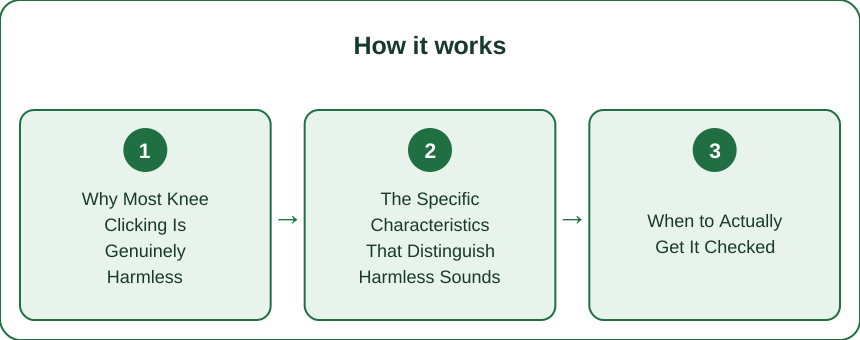
When Should You Actually Get It Checked?
Book an appointment if:
- Clicking is newly accompanied by pain, swelling, or a sense of instability
- A previously stable, painless pattern has changed noticeably in character or frequency without an obvious explanation
- The knee locks, gives way, or won’t fully straighten
- Any of the above followed a specific injury — a twist, a landing, an impact
Don’t book because of the sound alone, if it’s longstanding, painless, and unaccompanied. That’s not neglect; it’s an accurate reading of what the sound means, and every clinician you see will tell you the same thing.
If you do go, bring specifics. When it started, which movement produces it, what accompanies it, and whether there was an injury. That turns a vague complaint into something a clinician can actually work with, and it usually shortens the process considerably.
In the meantime, keep moving. Strong quadriceps, hamstrings, and glutes support the knee, and building that strength sometimes reduces the mechanical clicking from tendons shifting. Bodyweight squats, step-ups, and glute bridges — done painlessly, 2–3 times a week — are the practical version. Comfortable high waist leggings with a wide waistband make deep knee flexion and floor work considerably less of a fight, which matters when the goal is consistency rather than intensity.
If a movement hurts, don’t push through it. Painless is the operative condition.
When to see a professional: pain, swelling, instability, locking, inability to fully straighten, or any post-injury change. This is general information, not medical advice.
FAQ
Does clicking mean I’ll get arthritis?
Painless joint noise on its own isn’t established as a predictor of future arthritis. Pain, swelling, and stiffness are the symptoms that carry information; the sound by itself doesn’t.
Why is it worse in the morning?
Joints are stiffer after periods of immobility, and fluid and soft tissue positions shift overnight. Noise that eases as you move around is typical of the benign mechanisms.
Can I make it stop?
Strengthening the surrounding muscles sometimes reduces it, and improving hip and ankle mobility can help. But if it’s painless, eliminating the sound isn’t really the goal — and some knees simply click.
TL;DR
- Two benign mechanisms explain most knee noise: gas bubbles in joint fluid, and tendons sliding over bone.
- The sound itself carries no diagnostic weight — not volume, not frequency.
- What matters is what accompanies it: new pain, swelling, instability, or a clear change after injury.
- Locking or inability to straighten warrants prompt attention regardless of sound.
- Keep training painlessly — strong surrounding muscles support the joint and sometimes reduce the clicking.
Keep Reading
This article is for general informational purposes only and is not medical advice. Always consult a qualified health professional for guidance specific to you.