Why Your Knees Click and Pop So Much (and the Specific Signs That Actually Warrant Concern)
Quick Answer: Most knee clicking and popping is harmless — usually gas bubbles releasing in joint fluid, or a tendon shifting over a bony bump. Noise by itself isn’t a warning sign. What matters is what comes with it: pain, swelling, or the knee feeling like it might give way. Those three change the picture.
Every squat, every stair, every time you stand up from a chair — click.
It’s loud enough that other people notice, which somehow makes it worse. And nobody who tells you “that’s normal” ever explains why it’s normal.
This is general information, not medical advice.

Why Do Knees Click and Pop So Much?
Two benign mechanisms account for the great majority of it.
Gas bubbles in joint fluid. Your joints contain synovial fluid with dissolved gases. Pressure changes during movement let small bubbles form and release, producing an audible pop. This is essentially the same process as cracking a knuckle, and it happens throughout the body — the knee is just large, superficial, and moving constantly, so you hear it more.
Tendons and ligaments shifting over bone. As the knee bends and straightens, soft tissue slides across bony prominences. When it catches slightly and then releases, you get a click. Completely mechanical, completely unrelated to damage.
Both are ordinary. Neither involves anything wearing out, and neither predicts future joint problems on its own.
That’s worth sitting with, because knee clicking generates a genuinely disproportionate amount of worry relative to what it usually means.
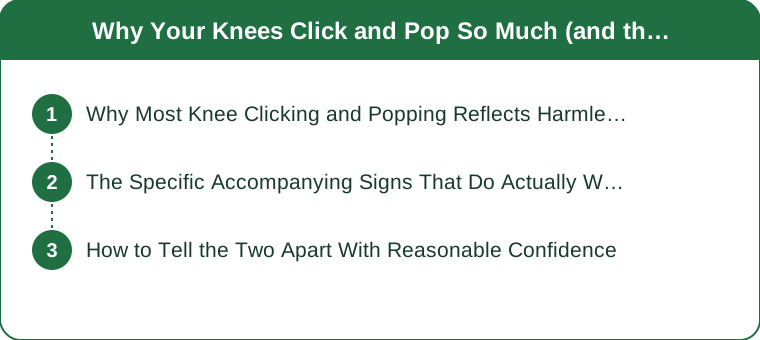
What Signs Actually Warrant Concern?
The sound is not the signal. The company it keeps is.
Pain during the same movement that produces the noise. Not general soreness afterward — pain at the click itself. That combination is worth attention.
Noticeable swelling. Visible puffiness, or a knee that feels tight and full. Swelling means the joint is reacting to something.
Instability, or the knee giving way. A sense that the joint might buckle under you, or has. This is the one people most often minimize and shouldn’t.
A clear recent change in the noise’s frequency or character — particularly after a specific injury event. A knee that’s clicked identically since you were nineteen is a different situation from one that started clicking loudly after you twisted it last month.
How to weigh these: any one of them, present alongside the noise, is a reason to get it looked at. All of them together, or any of them after a specific injury, means sooner rather than later.

Myth vs. Fact
Myth: Clicking knees mean arthritis is coming. Fact: Painless joint noise on its own isn’t an established predictor of future arthritis. Pain, swelling, and stiffness are the symptoms that carry information.
Myth: Louder means worse. Fact: Volume tracks anatomy and mechanics, not severity. A dramatic pop can be entirely benign; a quiet click with pain matters more.
Myth: You should avoid squats and stairs if your knees click. Fact: Avoiding painless movement tends to weaken the muscles supporting the joint, which helps nothing. If it doesn’t hurt, keep moving.
Myth: Cracking your knees causes damage, like people say about knuckles. Fact: The knuckle-cracking claim itself is poorly supported, and the same gas-bubble mechanism in the knee isn’t a damage process.
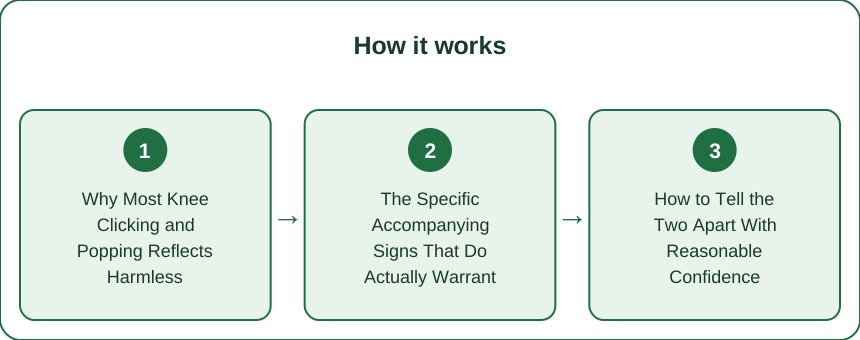
How Do You Tell the Two Apart Yourself?
Two practical checks, both of which you can do today.
Check 1: Does it hurt, swell, or feel unstable? Move through the noise-producing motion deliberately — a slow bodyweight squat, or a few stairs. Note honestly whether there’s pain at the click, whether the knee looks or feels swollen afterward, and whether it feels solid under you. Clean on all three, repeated consistently: consistent with the benign mechanisms.
Check 2: Is this new, or is this just you? A longstanding, unchanging, painless pattern is reassuring. Something that appeared suddenly, especially after a specific twist, impact, or landing, is a different question regardless of how it feels today.
If both checks come back clean, the reasonable response is to stop monitoring it. Constant attention to a benign noise tends to amplify the worry without changing anything.
If either check flags, book an appointment. Bring specifics: when it started, what movement produces it, what accompanies it, and whether there was an injury. That’s a far more useful ten minutes for a clinician than “my knee makes a noise.”
One thing that genuinely helps either way: strong quads, hamstrings, and glutes support the joint and often reduce the mechanical clicking from tendons shifting. Squats, step-ups, and bridges — done painlessly — are the practical version of that. Comfortable high waist leggings with a wide waistband make floor work and deep knee flexion less of a fight, which sounds trivial until you’re doing it three times a week.
When to see a professional: pain, swelling, instability, locking, or an inability to fully straighten the knee all warrant medical evaluation — as does noise that changed after an injury. This is general information, not medical advice.
FAQ
Should I stop exercising if my knees click?
Not if it’s painless. Painless clicking isn’t a reason to avoid movement, and reduced activity generally weakens the muscles that support the joint.
Why do my knees click more in the morning or after sitting?
Joints are stiffer after periods of immobility, and fluid and soft tissue positioning shift. Noise that eases as you move around is typical of the benign mechanisms.
Can I make the clicking stop?
Sometimes strengthening the surrounding muscles reduces it, and sometimes it’s just how your knee is built. If it’s painless, the goal isn’t really to eliminate the sound.
TL;DR
- Most knee noise is benign — gas bubbles in joint fluid, or tendons shifting over bone.
- The sound itself carries little information. What accompanies it does.
- Warning signs: pain at the click, swelling, instability or giving way, or a clear change after an injury.
- Two checks: is it painless/stable, and is it longstanding or new? Clean on both means you can stop worrying about it.
- See a doctor for pain, swelling, instability, locking, or post-injury changes.
Keep Reading
This article is for general informational purposes only and is not medical advice. Always consult a qualified health professional for guidance specific to you.